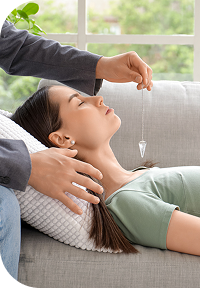
Willoughby, OH residents work with Tiffani Cappello, CHT, NLP, CLC for panic attacks, insomnia, IBS, emotional eating, chronic pain, unwanted habits, and stress-related conditions, with sessions available in nearby Chesterland and Lyndhurst or virtually from anywhere in Ohio.
A person dealing with panic attacks and a person dealing with insomnia rarely think their problems are related. Neither does someone managing IBS flare-ups or someone who reaches for food after a stressful call. On the surface these look separate. Underneath, each usually traces back to the same source: an automatic brain response that now runs faster than conscious thought can intervene. Clinical hypnosis works directly with that layer, identifying the learned pattern and giving it a chance to change.
Clients from Willoughby come to Geauga Mind Body Hypnosis for a range of reasons — some have hit a plateau with medication or talk therapy, others want a complementary approach, and some are managing a physical symptom like chronic pain or gut distress that hasn’t responded to standard treatment. Sessions draw on structured, evidence-informed protocols adapted to each client’s history and triggers.
The goal is a shift in the underlying pattern, not relief that fades by next week. Clients often notice change beyond the original complaint — someone treated for driving anxiety may find general stress dropping too. Willoughby clients can see Tiffani in person at the Chesterland or Lyndhurst office, a manageable drive via Route 2 or I-90, or meet virtually.

#1 Best Rated 2026
Winner
Ranked #1 among Willoughby Hypnotherapy businesses for 2026 • Quality Score: 95%+
Below are some of the conditions most commonly addressed in sessions with Willoughby clients.

You can be confident and capable in most areas of your life and still find yourself avoiding the highway, rehearsing what you are going to say before a conversation, worrying for hours about something that probably won’t happen, or feeling intense fear in situations other people barely think about. You may know the fear is out of proportion and still be unable to switch it off. That disconnect between what you know intellectually and how your brain and body automatically respond is one of the most frustrating things about anxiety.
Anxiety can show up as persistent worry and overthinking, social anxiety and fear of judgment, driving anxiety, performance anxiety, fear of flying, medical or dental fears, claustrophobia, fear of heights, or other specific fears and phobias. Avoidance often makes life feel easier temporarily, but it can also reinforce the brain’s belief that the situation really was dangerous, allowing anxiety to become stronger and more restrictive over time.
Hypnosis for anxiety works with the subconscious beliefs, learned associations, and automatic fear responses maintaining these patterns. The goal is not simply to become better at coping with anxiety. It is to change the learned response so situations that are actually safe no longer produce the same unnecessary alarm. I work with clients surrounding Cleveland communities for generalized anxiety, social anxiety, driving anxiety, performance anxiety, fears, phobias, and other anxiety-related concerns.


Sleep becomes increasingly difficult when the brain begins associating bedtime with effort, frustration, and the expectation of another bad night. You may struggle to fall asleep, wake repeatedly during the night, wake far too early, or find that your mind becomes more active precisely when you need it to settle. Over time, worrying about sleep can become part of the insomnia cycle itself.
Chronic insomnia is not always simply a matter of poor sleep habits. Stress, anxiety, overthinking, conditioned arousal, and learned associations between bedtime and wakefulness can keep the brain alert when it should be transitioning into sleep. Even after the original source of stress has passed, that learned pattern can remain.
Hypnosis for insomnia and sleep problems works with the subconscious patterns and conditioned responses that interfere with the natural sleep process. The goal is to reduce nighttime mental and physical arousal, rebuild the association between bed and sleep, and allow falling asleep and staying asleep to become automatic again rather than something you have to consciously force. I provide hypnosis for insomnia and sleep difficulties to clients surrounding Cleveland communities.
Panic attacks can feel sudden, frightening, and completely unpredictable. A racing or pounding heart, chest tightness, shortness of breath, dizziness, shaking, nausea, tingling, or a feeling of unreality can create an overwhelming fear that you are losing control, going to pass out, or experiencing a medical emergency. After the first few episodes, many people develop a fear of having another panic attack, leading to constant symptom monitoring, anticipatory anxiety, and avoidance of driving, crowded places, restaurants, stores, travel, or situations where escape feels difficult. Over time, this fear cycle can contribute to panic disorder and agoraphobia.
For clients experiencing recurring panic attacks, Panic2Calm™ is a specialized educational process that teaches you how to stop the subconscious fear loop that keeps panic going. You learn why fear of the sensations themselves can trigger and reinforce additional panic attacks and how to respond differently so the cycle is no longer strengthened. When underlying anxiety, trauma, or learned fear responses also need to be addressed, hypnosis can be used separately as part of a broader approach to resolving the patterns that


Irritable bowel syndrome can affect far more than digestion. IBS symptoms such as abdominal pain, cramping, bloating, diarrhea, constipation, and sudden bowel urgency can make it difficult to travel, eat at restaurants, attend events, or go somewhere without first thinking about bathroom access. For many people, stress and anxiety can trigger or worsen digestive symptoms, creating a frustrating gut-brain cycle in which fear of an IBS flare-up creates additional stress that further affects the digestive system.
Gut-directed hypnotherapy for IBS focuses specifically on the communication between the brain, nervous system, and digestive tract. This evidence-based approach can help improve overall IBS symptoms for some people while addressing the stress, anxiety, and heightened nervous-system responses that can intensify digestive distress. For clients struggling with irritable bowel syndrome or stress-related digestive problems, gut-directed hypnotherapy offers a mind-body approach designed to help calm the gut-brain connection and reduce the disruption that unpredictable digestive symptoms can cause in everyday life.
Chronic stress, anxiety, and prolonged periods of feeling unsafe can leave the nervous system hypervigilant, causing the brain and body to remain on high alert even when there is no immediate danger. You may feel wired but exhausted, easily overwhelmed, unable to fully relax, or unusually focused on sensations in your body. Nervous system sensitization can also be associated with persistent physical symptoms such as chronic pain, recurring headaches or migraines, muscle tension, dizziness, fatigue, digestive problems, and other symptoms that become worse during periods of stress or fear.
When appropriate, Pain and Symptom Reprocessing Therapy can help change learned brain and nervous system patterns that may be maintaining or amplifying certain persistent symptoms after appropriate medical evaluation. By reducing fear of symptoms and interrupting the cycle of hypervigilance, symptom monitoring, fear, and nervous system activation, this approach can help the brain interpret safe sensations more accurately. For clients, hypnosis and mind-body approaches may also be used to address the stress, anxiety, and learned responses that keep the nervous system stuck in a state of high alert.


Chronic stress can leave you feeling as though there is always something else to handle and never enough time or energy to recover. You may struggle with overthinking, racing thoughts, irritability, difficulty sleeping, mental exhaustion, decision fatigue, or feeling overwhelmed by responsibilities that you once managed easily. For high-achieving professionals, business owners, caregivers, and others carrying significant responsibilities, burnout can develop gradually—showing up as emotional exhaustion, loss of motivation, difficulty concentrating, reduced patience, and the feeling that your mind never truly shuts off.
Hypnosis for stress management and overwhelm can help address the automatic thought patterns, emotional responses, and learned behaviors that keep the mind and body stuck in a cycle of chronic stress. Hypnosis can help with overthinking, perfectionism, difficulty setting boundaries, the need to control every outcome, and the constant mental pressure to keep doing more. For clients experiencing chronic stress, burnout, mental overload, or emotional exhaustion, the goal is greater resilience, clearer thinking, healthier responses to pressure, and the ability to manage a demanding life without feeling consumed by it.
Low confidence and self-doubt can affect your career, relationships, decision-making, and willingness to pursue new opportunities. You may constantly second-guess yourself, compare yourself to others, struggle with negative self-talk, fear failure or rejection, or feel as though you are never quite good enough. Even highly successful people can struggle with imposter syndrome, perfectionism, fear of making mistakes, people-pleasing, and a persistent need for reassurance or approval despite having clear evidence of their abilities and accomplishments.
Hypnosis for confidence and self-esteem can help address the deeper beliefs and learned patterns that shape how you see yourself and what you believe you are capable of achieving. By changing automatic patterns of self-criticism, limiting beliefs, and fear of failure, hypnosis can help you trust your decisions, set healthier boundaries, communicate more confidently, and stop allowing self-doubt to determine what you do or avoid. For clients the goal is genuine self-confidence and stronger self-esteem that come from within rather than depending on achievement, perfection, or the approval of others.


Depression does not always look like intense sadness. It can also feel like emotional numbness, low energy, loss of motivation, irritability, hopelessness, or no longer enjoying activities and relationships that once mattered to you. You may withdraw from other people, struggle to get started in the morning, procrastinate on everyday responsibilities, experience changes in sleep, or feel trapped in negative thinking, low self-worth, and a lack of interest or pleasure in life.
Hypnosis for depression and low mood can be used as a complementary approach to help address negative beliefs, emotional patterns, and learned responses that may contribute to feeling stuck. Hypnosis can help support healthier patterns of thinking, improve self-perception, reconnect you with motivation and positive emotions, and make it easier to take meaningful steps forward. For clients, hypnosis may be used alongside appropriate mental health or medical care to support emotional well-being, motivation, confidence, and a renewed sense of connection and purpose.
Emotional eating can make weight loss feel frustrating, especially when you know what you want to change but continue falling back into the same patterns. You may eat in response to stress, anxiety, boredom, loneliness, or overwhelm, struggle with food cravings or nighttime eating, eat past the point of fullness, or find yourself repeatedly losing weight only to regain it. For many people, the problem is not a lack of knowledge about healthy eating, it is the emotional triggers, automatic habits, cravings, and patterns of self-sabotage that make lasting change difficult.
Hypnosis for weight loss and emotional eating can help address the subconscious patterns and learned associations that influence eating behaviors. By changing automatic responses to stress, emotional triggers, food cravings, and habitual eating, hypnosis can help you feel more in control of your choices and develop a healthier relationship with food. For clients struggling with emotional eating, overeating, food cravings, weight loss motivation, or maintaining weight loss, the goal is to create lasting changes in mindset and behavior rather than relying on another restrictive diet or a constant battle with willpower.


Pain can continue long after the body has healed because pain is not produced by the injured body part alone. It is ultimately created by the brain in response to information from the body, past experiences, perceived danger and the nervous system’s assessment of threat. For some people with chronic pain, extensive testing finds no structural explanation for the severity or persistence of their symptoms. For others, a physical condition exists, but the intensity of the pain is greater than the tissue damage alone would predict.
This is where the growing understanding of neuroplastic pain and mind body disorders becomes important. The brain can learn pain just as it learns other protective responses. Chronic back pain, neck pain, headaches, migraines, pelvic pain, fibromyalgia symptoms and other persistent physical symptoms can sometimes involve a nervous system that has become highly sensitized to perceived danger. The pain is real, but the mechanism maintaining it may be different from an ongoing injury.
Hypnosis for chronic pain works with the brain and nervous system rather than simply trying to distract you from discomfort. I incorporate principles from Pain and Symptom Reprocessing Therapy (PRT) and Hypnosis helps clients change fear-based associations with physical sensations, reduce the brain’s perception of threat and develop new responses to sensations that have become linked with danger.
Mind body disorders can also involve symptoms beyond pain. Some people experience persistent muscle tension, digestive symptoms, fatigue or other physical sensations that become worse during periods of stress or emotional strain. Recognizing a mind body component does not mean the symptoms are imaginary or “all in your head.” It means the brain, nervous system and body are interacting in ways that can potentially be changed.
Chronic pain should always be medically evaluated to identify or rule out structural disease, injury or other conditions requiring medical care. When symptoms persist after healing, move from one area of the body to another, fluctuate significantly, or become stronger during periods of stress, the nervous system may be playing a role in keeping the pain response active. Hypnosis, Pain Reprocessing Therapy and mind body approaches can help retrain the brain’s response to these sensations, reducing the fear and perceived danger that can reinforce chronic pain.
If you keep promising yourself that you are going to stop and then find yourself doing it again, the problem may be bigger than simply needing more willpower. Smoking, excessive drinking, binge drinking, compulsive sexual behavior, pornography use, nail biting, skin picking, hair pulling, motor or vocal tics and other unwanted habits can become deeply conditioned patterns connected to stress, boredom, anxiety, relief, reward or familiar routines.
Hypnosis for bad habits and addictions works with the subconscious triggers and learned associations that can make a behavior feel automatic. Someone searching for hypnosis to quit smoking, help to stop drinking or reduce alcohol use, hypnosis for sex addiction or compulsive sexual behavior, help with pornography addiction, hypnosis for nail biting, skin picking, hair pulling or tics may be dealing with very different behaviors, but the underlying pattern can be remarkably similar: a trigger creates an urge, the behavior temporarily satisfies that urge, and repetition strengthens the cycle.
Transformational Hypnosis focuses on identifying what your brain has learned to associate with the behavior and changing the beliefs, emotional triggers and reward patterns helping to keep it going. The goal is not to spend the rest of your life fighting cravings or forcing yourself to resist an unwanted habit. It is to change the subconscious pattern so that you have greater choice over what you do when the old trigger appears.
For alcohol or other substance dependence, hypnosis should be used as a complementary approach and not as a substitute for appropriate medical or addiction care. Physical dependence on alcohol can make suddenly stopping dangerous and may require medical supervision.


Sometimes the closer you get to something you really want, the more reasons you suddenly find not to move forward. You procrastinate on the opportunity you were excited about, talk yourself out of taking the risk, abandon a goal after making real progress, choose the wrong relationship again, or find some other way to get in your own way. Then comes the frustrating question: “Why do I keep sabotaging my life?”
Self-sabotaging behavior can be driven by subconscious beliefs and learned emotional patterns that operate outside conscious awareness. Fear of failure is an obvious example, but fear of success, perfectionism, low self-worth, imposter syndrome, procrastination, people pleasing and fear of rejection can also keep someone stuck. Sometimes avoiding the next step feels safer to the subconscious mind than risking failure, judgment, responsibility or change.
Hypnosis for self-sabotage works with the subconscious beliefs and automatic patterns behind these behaviors. Transformational Hypnosis can help uncover why part of you keeps resisting what another part genuinely wants and change the associations that have made avoidance, procrastination or self-defeating behavior feel necessary. The goal is to stop fighting yourself so that your thoughts, choices and behaviors begin supporting the life you consciously want.
All sessions are customized to your unique personality and background – whether you’re a student, business owner, essential worker, or caregiver. The goal is to help you feel emotionally safe, grounded, and capable again
Below are some of the conditions most commonly addressed in sessions with Willoughby clients.

For some Willoughby residents, driving anxiety shows up as tight hands on the wheel and a racing pulse on I-90 or the Route 2 interchanges near Willoughby, particularly during merges, heavy traffic, or bad weather. Others notice it more specifically around bridges, highway on-ramps, or driving after dark, sometimes avoiding certain routes altogether even when it adds significant time to a commute.
Hypnosis addresses the learned association between driving and danger that the brain has formed, often from a past accident, a near-miss, or repeated stress exposure behind the wheel. Clients typically report feeling more in control of their physical response while driving, with less need to plan routes around avoidance.


Panic attacks tend to arrive without clear warning — a racing heartbeat, shortness of breath, chest tightness, or a wave of dread that hits during a meeting, in a grocery store, or while sitting in traffic. Many clients describe the fear of a panic attack becoming its own problem, layered on top of the original trigger, until certain places or situations get avoided entirely.
The Panic2Calm™ approach works by interrupting the automatic fear response before it escalates and retraining how the brain interprets early physical sensations. Clients generally notice fewer episodes over time and more confidence that they can handle the ones that still occur.


IBS symptoms frequently intensify around predictable stress points — before a work presentation, during a family gathering, or on a morning commute — with cramping, bloating, or urgent bathroom needs that can make ordinary plans feel unreliable. The gut-brain connection means emotional stress and digestive symptoms often escalate together.
Gut-directed hypnosis, one of the more researched applications of clinical hypnosis, targets the nervous system signaling between the brain and the digestive tract. Many clients notice fewer flare-ups and more predictable digestion as the stress response calms.


Low confidence often shows up as rehearsing conversations before they happen, downplaying accomplishments at work, or hesitating to speak up in meetings even when the input is valuable. For some Willoughby clients it’s tied to a specific area, like public speaking or job interviews; for others it affects most decisions.
Hypnosis targets the internal narrative and the subconscious associations formed around past criticism or failure, replacing the automatic self-doubt response with a steadier baseline. Clients often describe speaking up more readily and second-guessing themselves less.


Emotional eating usually isn’t about hunger. It’s reaching for food after an argument, snacking through a stressful evening of email, or eating past fullness during a period of high pressure at work, followed by frustration that willpower alone hasn’t fixed the pattern.
Hypnosis addresses the emotional trigger-to-food association directly, rather than relying on restriction or willpower, which tends to break down under stress. Clients often report a noticeable gap between the urge to eat and the automatic reach for food, giving them room to choose differently.

Every session is built around your specific personality, schedule, and background — a student’s stress looks different than a business owner’s, and a caregiver’s looks different than an essential worker’s. The goal is to help you feel emotionally safe, grounded, and capable again.




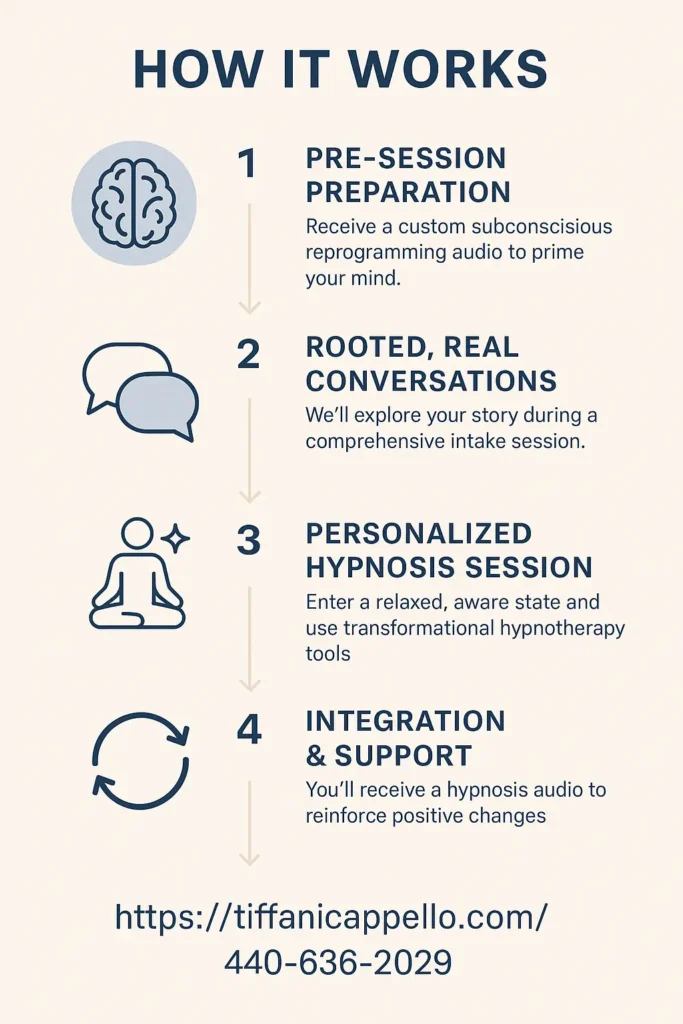
In your 2 hour session, you’ll enter a relaxed, aware state (similar to guided meditation). Here, we use transformational hypnotherapy tools such as:
You’re fully in control the entire time, but connected to a deeper, calmer part of yourself — not just thinking about change, but experiencing it.
After your hypnosis session, you’ll receive a customized subconscious reprogramming audio to reinforce and hard-wire the internal changes. Clients are instructed to fall asleep to the recording each night for 30 days. This effortless routine allows the subconscious mind to absorb new patterns of calm, confidence, and emotional balance, helping to ease anxiety, overthinking, and stress-related tension naturally and effectively.
⭐⭐⭐⭐⭐
“I saw Tiffani with Geauga Mind Body Hypnosis to help ease my anxiety. After one session with Tiffani, my anxiety reduced significantly and I was able to live my life like normal without anxiety ruining my day. I have been able to manage my daily anxiety much better after having listened to my 30 day recording. Tiffani is truly so kind and cares for each person she works with, helping you to dive deeper into the root of your issues. I highly recommend Tiffani to anyone and everyone. She is wonderful!”
Willpower and logic operate through the conscious, analytical part of the brain, which is also the slowest part to respond. Automatic patterns — a phobic response to driving, a craving triggered by stress, a pain signal that’s become chronic — run through faster, more automatic pathways that conscious effort often can’t override in the moment. This is why someone can know, intellectually, that a panic attack isn’t dangerous and still experience the same physical response every time.
Hypnosis works with those faster, more automatic pathways directly instead of trying to out-reason them. By addressing the pattern at the level where it was formed, the response itself starts to change, rather than requiring constant conscious effort to manage a symptom that keeps recurring. That’s typically why clients who’ve had limited success with talk-based approaches see different results with hypnosis — the target is the mechanism producing the pattern, not just the thoughts about it.
Whether you’re exploring how subconscious patterns drive emotions or want tools to build self-trust, our LIVE and online guide you through deep, empowering change.
On A Transformed Life, Tiffani dives into emotional healing, real-life change stories, and mind-body breakthroughs. Perfect for busy listeners seeking insights on-the-go.
Visual learner? Explore mini sessions, transformation stories, and expert breakdowns of how hypnosis works on Tiffani’s YouTube Channel.
Clinical Hypnotherapist

Rapid Transformational Practice

Certified Life Coach

Licensed Physical Therapist Assistant

Certified Nutritional Consultant

2025 Quality Business Award

2026 Quality Business Award

“I had been dealing with years of panic attacks that affected every aspect of my life. Tiffani took the time to listen and then created a personalized transformational session. I finally feel in control of my emotions again.”
“After just one session, my anxiety significantly reduced, and I could live my life without it ruining my day. I’ve been able to manage my stress in ways I didn’t think were possible.”
— Zach B.
“For five years, I dealt with chronic stress, low energy, and self-doubt. Tiffani’s tailored program helped me finally feel unstuck. I’ve regained motivation and confidence.”
— Joan L.
Both options are available. Many Willoughby clients choose virtual sessions for convenience, while others prefer the in-person setting at one of the two office locations.
No. Hypnosis is a state of focused relaxation and concentration. Clients remain aware and can speak or respond throughout the session.
This depends on the condition and the program selected. Some clients notice change within the first few sessions, while conditions like chronic pain or long-standing habits often benefit from a structured multi-session program like the 30 Day Transformational Hypnosis Package.
No. Hypnosis is used as a complementary approach and works alongside, not in place of, care from a medical or mental health provider, particularly for conditions like depression.
Yes. Many clients find that addressing one pattern, such as chronic stress, produces improvement in related areas, like sleep or digestion, since these systems are often connected.
Book a FREE Consultation and take the first real step toward lasting relief.
If you’re in Willoughby and dealing with panic attacks, insomnia, chronic pain, IBS, or another pattern that hasn’t responded to other approaches, a free consultation is available to talk through what’s going on and whether hypnosis is a good fit.