
Struggling with bloating, digestive discomfort, urgency, nausea, or unpredictable IBS symptoms can feel exhausting—especially when you’ve already tried changing your diet and avoiding triggers. Through gut-directed hypnotherapy and subconscious pattern work, this approach focuses on calming the nervous system, reducing digestive reactivity, and helping the gut-brain connection become less stuck in cycles of stress and symptom anticipation.

Irritable Bowel Syndrome (IBS) is considered a functional digestive condition.
That means the symptoms are real, but they are not always explained by visible structural damage or disease.
For many people, IBS involves a highly sensitive communication system between the brain, nervous system, and digestive tract. This relationship is often referred to as the gut-brain axis.
The gut and brain are constantly sending signals back and forth to each other. When the nervous system becomes stuck in patterns of stress, hypervigilance, or subconscious threat responses, the digestive system can become increasingly reactive and sensitive over time.
This is one reason symptoms may:
For many people with IBS, the body begins reacting not only to food, but also to:
Over time, the brain and nervous system can become highly focused on digestive sensations, making the gut more reactive and more easily triggered.
This does not mean the symptoms are imagined.
It means the gut and nervous system may have become stuck in a learned stress-response pattern that continues reinforcing digestive sensitivity over time.
Understanding the gut-brain connection is often an important part of understanding why IBS symptoms can feel so persistent, unpredictable, and difficult to fully calm.
The gut and nervous system are deeply connected. When the digestive system becomes stuck in patterns of stress reactivity, hypersensitivity, or subconscious anticipation, symptoms can begin feeling difficult to predict or control.
This work focuses on stress-responsive digestive patterns often associated with:
For many people, the symptoms themselves become stressful. Over time, the nervous system can begin anticipating discomfort before it even happens—especially in situations involving food, travel, public places, social settings, work pressure, or uncertainty around symptom control.
This can create a cycle where the digestive system stays increasingly reactive, alert, and difficult to calm.
The goal of this work is not simply symptom management. It is helping the brain, nervous system, and gut begin responding differently so the digestive system no longer stays stuck in constant stress and symptom anticipation.
For many people with IBS, the digestive system gradually becomes more reactive over time.
What may begin as occasional digestive discomfort can eventually turn into a pattern where the brain, nervous system, and gut stay increasingly focused on anticipating symptoms.
The nervous system learns:
Over time, the body can begin responding automatically—even before there is a true digestive problem happening.

This is one reason symptoms may continue even when:
For many people, the fear of symptoms eventually becomes part of the symptom cycle itself.
The brain begins associating:
with possible discomfort or loss of control.
As this pattern repeats, the nervous system can become increasingly sensitized and hypervigilant around digestive sensations.
This creates a loop where:
Over time, the cycle becomes automatic.
This does not mean the symptoms are “all in your head.”
It means the brain, nervous system, and gut may have become stuck in a learned stress-response loop that continues reinforcing digestive sensitivity and symptom anticipation.
And until that pattern begins changing, the body often continues reacting in the same familiar way.
Your gut and brain are constantly communicating with each other through the nervous system.
When the brain perceives stress, uncertainty, fear, pressure, or potential threat, those signals can directly affect:
For many people with IBS, this communication system gradually becomes stuck in a repeating stress-response loop.
The digestive system becomes increasingly focused on:
Over time, the nervous system can begin reacting automatically to digestive sensations that may previously have felt neutral or manageable.
This creates a repeating cycle:
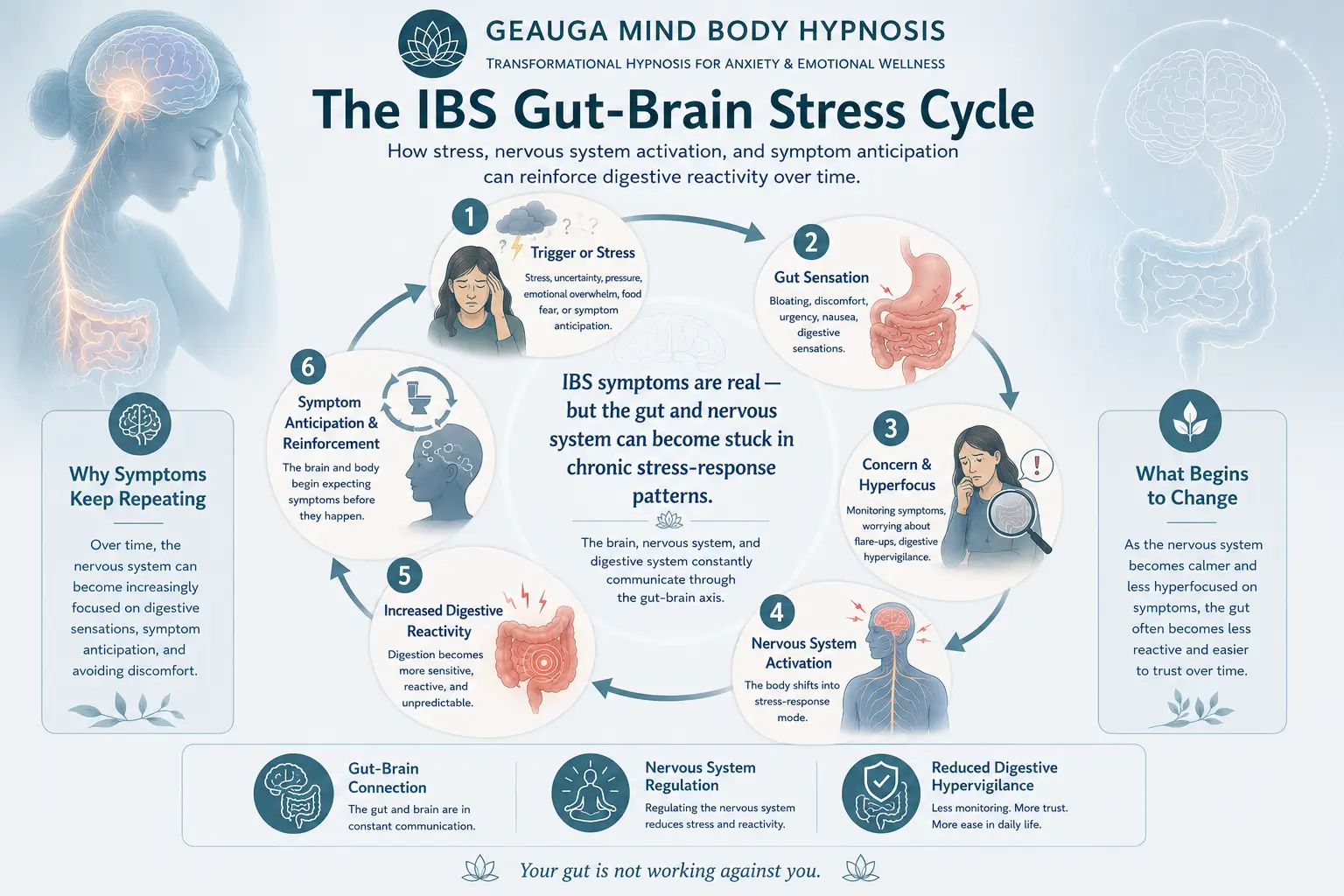
As the cycle repeats:
Eventually, the body can begin expecting symptoms before they even happen.
For many people, this is why IBS can feel exhausting, frustrating, and difficult to fully calm—even when they are actively trying to improve their health.
This does not mean the symptoms are imagined.
It means the brain, nervous system, and digestive system may have learned a chronic stress-response pattern that continues reinforcing digestive sensitivity over time.
And like many learned nervous-system patterns, that cycle can begin changing when the brain and body no longer stay stuck in constant anticipation, hypervigilance, and stress reactivity.
Gut-directed hypnotherapy is a specialized form of hypnosis designed to work with the communication system between the brain, nervous system, and digestive tract.
Rather than focusing only on food or symptom management, this approach focuses on helping calm the stress-response patterns that can keep the gut reactive, sensitive, and hyperfocused on digestive sensations.
Gut-directed hypnotherapy has been used to help support:
For many people with IBS, the nervous system becomes stuck in patterns of chronic monitoring, stress reactivity, and subconscious anticipation around symptoms.
Over time, the brain can begin treating digestive sensations as signals of danger or loss of control—even when there is no immediate threat present.
This work focuses on helping the brain and nervous system begin responding differently so the digestive system no longer stays locked in constant stress activation and symptom anticipation.
As the nervous system begins calming and the brain becomes less focused on monitoring digestive sensations, the gut often becomes less reactive over time as well.
Traditional gut-directed hypnotherapy often focuses primarily on relaxation and calming digestive responses.
This work goes deeper by combining gut-focused hypnosis with subconscious pattern work and nervous system regulation.
The goal is not only to help calm the digestive system temporarily but also to help identify and shift the subconscious stress-response patterns that may be keeping the gut stuck in cycles of hypervigilance, anticipation, and digestive reactivity.
For many people with IBS, the nervous system gradually learns:

Over time, these learned subconscious associations can keep the digestive system increasingly reactive—even when someone is actively trying to improve their health.
This approach combines:
to help the brain and body begin responding differently to digestive sensations, stress, uncertainty, and symptom anticipation.
As the subconscious and nervous system begin updating those learned responses, the brain often becomes less focused on digestive monitoring and threat detection.
And as that pattern begins changing, the gut often becomes calmer, less reactive, and easier to trust over time.
For many people with IBS, the nervous system becomes stuck in patterns of stress reactivity, digestive monitoring, symptom anticipation, and subconscious hypervigilance around gut sensations.
Over time, the brain can begin treating digestive symptoms as signals of danger or loss of control, which keeps the nervous system increasingly alert and the gut increasingly reactive.
Transformational Hypnosis works by helping calm and retrain those subconscious stress-response patterns.
Through this process:
As the brain and nervous system begin responding differently to digestive sensations, stress, uncertainty, and symptom-related fear, the gut often begins following that calmer pattern as well.
For many people, this creates a gradual shift where:
This work is not about forcing the body to “stop” symptoms through willpower.
It’s about helping the brain, nervous system, and digestive system begin moving out of chronic stress-response patterns that may have been reinforcing digestive sensitivity over time.

This work may be a strong fit if:
For many people, the most exhausting part is not only the physical symptoms themselves.
It’s the constant anticipation.
The monitoring.
The uncertainty.
The fear of symptoms happening at the wrong time or in the wrong place.
Over time, this can leave the nervous system feeling constantly alert and the digestive system increasingly reactive.
This work is designed to help address the subconscious and nervous-system patterns that may be contributing to that cycle so the gut, brain, and body can begin responding differently over time.
This work is not about saying your symptoms are “all in your head.”
IBS symptoms are real, physical, and often deeply disruptive to daily life.
The gut and nervous system are closely connected, which means stress, hypervigilance, subconscious patterns, and nervous system activation can strongly influence how digestive symptoms are experienced and reinforced over time.
That does not make the symptoms imagined.
And it does not mean you are causing them intentionally.
This work is also not a replacement for appropriate medical care, diagnosis, or treatment.
If you have symptoms requiring medical evaluation, ongoing care, or treatment, working with a qualified healthcare provider is important.
Instead, this approach focuses on the gut-brain connection and the subconscious stress-response patterns that may be contributing to ongoing digestive sensitivity, symptom anticipation, nervous system activation, and digestive reactivity.
The goal is not to “force” the body to stop symptoms.
It is helping the brain, nervous system, and digestive system begin responding differently so the body no longer stays stuck in chronic stress and digestive hypervigilance.
For many people, this creates a calmer and more regulated relationship with both their body and their symptoms over time.
Tiffani Cappello is a certified hypnotherapist specializing in anxiety, nervous system regulation, subconscious pattern work, and stress-responsive conditions connected to the gut-brain connection. Her approach combines Transformational Hypnosis, subconscious reconditioning techniques, and nervous system-focused approaches designed to help clients move beyond chronic cycles of stress reactivity, digestive hypervigilance, symptom anticipation, and emotional overwhelm.
With over 10 years of advanced training in hypnotherapy, emotional processing, subconscious pattern work, and NLP, Tiffani helps clients understand how the brain, nervous system, and body can become stuck in learned stress-response patterns that continue reinforcing physical symptoms over time.
Rather than focusing only on symptom management, her work is centered on helping clients calm the nervous system, reduce subconscious threat responses, and create healthier communication between the brain and body so symptoms no longer feel as consuming, reactive, or unpredictable.
Tiffani works with clients throughout Northeast Ohio and the greater Cleveland area through both in-person and virtual sessions.

Clinical Hypnotherapist

Rapid Transformational Practice

Certified Life Coach

Licensed Physical Therapist Assistant

Certified Nutritional Consultant

2025 Quality Business Award

2026 Quality Business Award

National Guild of Hypnotists
🏆 Recognized by Quality Business Awards for excellence in hypnotherapy in:
Mentor • Willoughby • Solon • Shaker Heights • Mayfield Heights
🏆 Additional Quality Business Award recognitions across Northeast Ohio include:
Euclid • South Euclid • Maple Heights • Garfield Heights • North Royalton • Painesville
Yes. The digestive system and nervous system are closely connected through the gut-brain axis. Stress, anxiety, hypervigilance, and nervous system activation can strongly influence digestion, gut sensitivity, motility, and symptom intensity for many people with IBS.
For many people, IBS symptoms are influenced by more than food alone. The nervous system, stress-response patterns, subconscious associations, and symptom anticipation can also contribute to digestive reactivity and flare-ups.
No. IBS symptoms are real physical symptoms. The gut and nervous system are deeply connected, which means stress and nervous system activation can affect how symptoms are experienced and reinforced over time. That does not make the symptoms imagined.
The gut-brain connection refers to the constant communication between the brain, nervous system, and digestive tract. When the nervous system becomes stuck in chronic stress or hypervigilance, digestive symptoms can become more reactive, sensitive, and difficult to calm.
Gut-directed hypnotherapy and Transformational Hypnosis may help support nervous system regulation, reduce digestive hypervigilance, calm subconscious stress-response patterns, and help the brain and gut begin responding differently over time.
For many people with IBS, the nervous system becomes increasingly focused on monitoring symptoms and anticipating flare-ups. Over time, the brain and body can begin reacting automatically to stress, uncertainty, digestive sensations, or learned subconscious associations connected to symptoms.
Yes. The nervous system can directly affect digestion, gut sensitivity, motility, muscle tension, and inflammation responses. Chronic stress activation can make the digestive system more reactive and more sensitive over time.
This approach combines gut-directed hypnotherapy with subconscious pattern work and nervous system regulation. Rather than focusing only on temporary relaxation, the goal is to help address the deeper stress-response patterns and subconscious associations contributing to ongoing digestive reactivity and symptom anticipation.
Yes. Gut-directed hypnosis may help people struggling with both constipation-predominant IBS and diarrhea-predominant IBS by helping calm the brain-gut connection and reduce the nervous system patterns that can keep digestive symptoms active.
Some people with IBS primarily struggle with constipation, bloating, abdominal pressure, straining, or the uncomfortable feeling that digestion moves too slowly. Others experience frequent loose stools, urgency, cramping, or fear around unpredictable digestive episodes. Many people fluctuate between both patterns over time.
Rather than focusing only on the digestive tract itself, gut-directed hypnosis works with the brain-gut axis and nervous system. The goal is to help reduce stress reactivity, calm digestive hypervigilance, decrease symptom amplification, and retrain subconscious patterns that may contribute to ongoing IBS symptoms.

You do not have to keep living in constant anticipation of symptoms.
You do not have to stay trapped in cycles of digestive monitoring, stress, urgency, unpredictability, or fear around how your body might react.
For many people with IBS, the most exhausting part is not only the physical discomfort itself.
It’s the constant hyperawareness.
The uncertainty.
The feeling that your nervous system and digestive system never fully relax.
But your body is not working against you.
Your gut and nervous system may simply be stuck in patterns of chronic stress activation, symptom anticipation, and subconscious digestive hypervigilance that have been reinforced over time.
And like many learned nervous-system patterns, those responses can begin changing.
As the brain, nervous system, and gut begin responding differently:
This work is not about forcing your body to “stop” symptoms through willpower or control.
It’s about helping the brain, nervous system, and digestive system move out of chronic stress-response patterns so your body no longer stays stuck in constant digestive alertness and reactivity.
Many people with IBS begin organizing their lives around their digestive symptoms.
Planning ahead for bathrooms. Avoiding certain situations. Constantly checking the body for signs of discomfort, urgency, bloating, cramping, or digestive changes.
Over time, the digestive system can begin feeling unpredictable and difficult to trust. For some people, even minor sensations trigger stress, tension, or anticipatory anxiety because the brain and nervous system have become highly conditioned to monitor the gut for potential problems.
This does not mean the symptoms are imagined. The symptoms are real. But in many cases, the brain-gut connection and nervous system become increasingly sensitized over time, creating a cycle of digestive stress reactivity and heightened symptom awareness.
Gut-directed hypnosis is designed to help interrupt those patterns by supporting healthier communication between the brain, nervous system, and digestive system.
As this process develops, many people notice changes such as:
Rather than fighting against the body, this work focuses on helping the nervous system move out of chronic digestive stress patterns so the gut no longer remains locked in a persistent state of tension, alarm, and overreactivity.
Schedule a consultation to explore how gut-directed hypnotherapy, subconscious pattern work, and nervous system regulation may help support calmer digestive responses and reduce chronic cycles of digestive hypervigilance, symptom anticipation, and stress-related gut reactivity.
Together, we’ll explore the patterns that may be contributing to ongoing digestive sensitivity and begin creating a calmer, more regulated relationship between the brain, nervous system, and gut.