
Panic attacks can feel sudden, overwhelming, and out of control—but they follow a predictable pattern in the mind and body. Using the Panic2Calm™ method, you’ll learn how panic works and how to stop the fear response at its source, helping you regain a sense of calm and control.

Panic attacks can feel sudden, overwhelming, and out of control, but they are actually driven by a predictable pattern in the brain and body.
At Geauga Mind Body Hypnosis, panic attacks are addressed using the Panic2Calm™ method—a targeted, educational approach that teaches you exactly how panic works and how to stop it.
Instead of trying to manage or suppress symptoms, you learn how to break the subconscious fear loop that drives panic. Once that loop is interrupted, panic attacks begin to lose their power—often very quickly.
After panic is resolved, Transformational Hypnosis is used to address the underlying subconscious patterns that created the anxiety in the first place, allowing for lasting and meaningful change.
A panic attack is not random, and it is not a sign that something is wrong with your body.
A panic attack is a sudden surge of intense physical symptoms caused by your brain and nervous system, even when there is no real danger present.
In the moment, panic attack symptoms can feel overwhelming. Your heart may race, your chest may tighten, your breathing may change, and you may feel dizzy, disconnected, or like you are losing control. For many people, these physical symptoms of panic are so intense that they feel like a medical emergency.
Because the symptoms are so physical, panic attacks are often mistaken for heart problems or other serious health conditions, especially in the beginning. It is always recommended that you are properly evaluated by a medical professional to rule out any underlying medical concerns.
Once medical causes have been ruled out, it becomes much easier to understand what is actually happening in the body.
What most people don’t realize is that panic attacks follow a specific internal pattern.
Once that pattern is activated, the body begins reacting in ways that feel automatic and difficult to control. This is why sudden panic attacks can seem unpredictable or as if they come out of nowhere.
But they are not coming out of nowhere.
There is a reason panic attacks happen, and more importantly, there is a way to change how your body responds.
Panic attacks do not always look the same for everyone.
While the physical symptoms of panic are often similar, the situations in which panic attacks occur and the patterns they follow can vary from person to person.
Over time, panic tends to become linked to specific situations, environments, or internal sensations. This is why some people experience panic attacks in very particular settings, while others feel like their panic happens without warning.
In my work, I focus on identifying these patterns and understanding how they develop, because once the pattern is clear, it becomes much easier to change.
Below are some of the most common panic attack patterns I see.
Sudden panic attacks can feel like they come out of nowhere.
You may be going about your day when a wave of intense physical symptoms suddenly hits. Your heart starts racing, your breathing changes, and your body shifts into a heightened state within seconds. Because there is no obvious trigger, these panic attacks often feel confusing, unpredictable, and difficult to control.
Many people begin to wonder why panic attacks happen suddenly or why their body is reacting this way without warning.
What most people don’t realize is that even panic attacks that feel random are still being driven by an internal pattern. The trigger is not always something external or obvious, which is why these episodes can seem to appear without any clear cause.
This is one of the most common forms of panic I see, and it is also one of the most misunderstood.


Panic attacks while driving can feel especially intense and difficult to manage.
For many people, driving anxiety or panic attacks happen in situations where it feels harder to stop or get out of the car. This often includes highways, heavy traffic, long distances, or crossing bridges, where the sense of being trapped can make the panic feel even stronger.
In these moments, the body can quickly shift into a panic response. Your heart may race, your breathing may become shallow, and you may feel lightheaded, disconnected, or like you need to escape immediately.
Because of this, many people begin avoiding certain roads, highways, or driving altogether, which can gradually make the problem worse over time.
Panic attacks while driving are very common, and they tend to follow a specific pattern that becomes linked to these environments.
The encouraging news is that this pattern can be changed, so people can return to driving feeling calm, steady, and back in control.
Panic attacks in public places can feel especially overwhelming and exposed.
For many people, panic begins in environments like stores, restaurants, shopping centers, or crowded spaces where it may feel difficult to leave quickly or get to a place of safety. This can create a heightened sense of vulnerability, as if all attention is on you or there is no easy escape.
In these situations, the body can quickly shift into a panic response. You may feel your heart racing, your breathing change, or a sudden urge to leave immediately. For some, this develops into a fear of having a panic attack in public, which can make even routine activities feel stressful.
Over time, this often leads to avoiding certain places, limiting social activities, or only going out when it feels “safe,” which can gradually shrink your world.
Panic attacks in public are very common, and they tend to follow a specific pattern that becomes associated with these environments.
The good news is that this pattern can be changed. With the right approach, you are able to return to public places feeling calm, confident, and fully in control again.


For many people, the fear of having another panic attack becomes just as difficult as the panic itself.
After the first panic attack, the experience can feel so intense and overwhelming that the brain begins to treat it as a serious threat. In many ways, that first panic attack is experienced as a trauma to the body.
From that point on, the brain shifts into a protective mode. It begins scanning for signs, monitoring physical sensations, and trying to prevent that experience from happening again. This is why many people develop a constant awareness of their body, anticipating symptoms or worrying about when the next panic attack might occur.
This is often referred to as the fear of panic attacks or anticipatory anxiety, and it can lead to avoiding situations, places, or even thoughts that feel like they could trigger another episode.
I understand this pattern not only professionally, but personally. I experienced panic attacks myself and lived with that same fear of when the next one would happen. That constant anticipation can feel exhausting and overwhelming.
What most people don’t realize is that this fear is actually what keeps the cycle going.
The brain is trying to protect you from what it believes is a dangerous experience, but in doing so, it unintentionally reinforces the panic response.
The good news is that this pattern can be changed.
Once you understand how to break the subconscious fear loop, your body no longer needs to stay in that protective state, and the cycle of panic can stop. This process is often much more straightforward than people expect.
Panic attacks at night can feel especially unsettling and difficult to understand.
For some people, panic begins while trying to fall asleep. For others, it shows up as a sudden awakening in the middle of the night with intense physical symptoms. You may wake up with your heart racing, your breathing changed, or a strong sense of fear without knowing why.
Because these nighttime panic attacks happen when the body is supposed to be resting, they can feel even more alarming and out of control.
Over time, this can create anxiety around sleep itself. You may start worrying about falling asleep, anticipating symptoms, or feeling uncertain about how your body will respond at night.
Once you learn how to stop the subconscious fear loop, your body no longer needs to react this way, and sleep can begin to feel safe and restful again.

The Panic2Calm™ method is a structured, educational approach designed to teach you how to stop panic attacks by changing how your mind and body respond to them.
Unlike traditional approaches that focus on managing panic attack symptoms, this method focuses on helping you understand what is happening internally and how to shift your response.
Panic attacks often continue because the same internal reaction is triggered repeatedly. Until that response changes, the cycle tends to repeat.
Through the Panic2Calm™ process, you learn how to respond differently so your body no longer reacts with the same level of intensity or urgency.
As you begin to apply what you learn, panic attacks lose their power and become less frequent.
This is not about coping with panic or avoiding it. It is about learning how to change the response that creates it so you can feel calm, steady, and back in control.
The Panic2Calm™ method is a structured, educational process that teaches you how to stop panic attacks by understanding and changing your body’s response.
This is not a passive process. You are actively learning a skill you can use
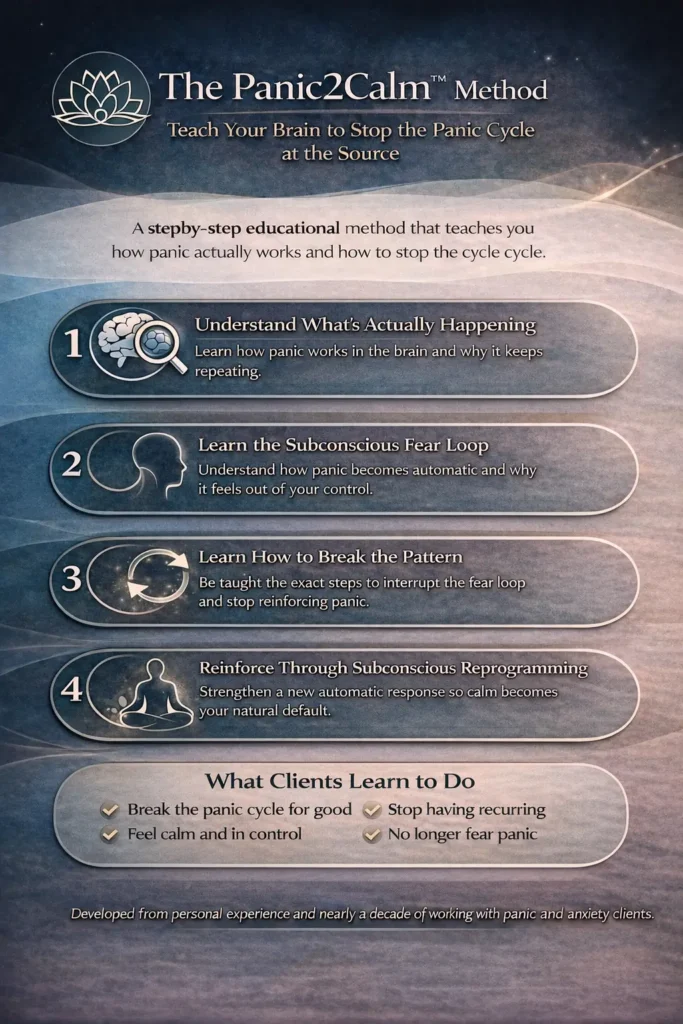
This is not traditional talk therapy or symptom-focused treatment. It is an educational process that teaches you how panic actually works in your brain and why it keeps repeating. Instead of focusing on coping with panic attacks, you learn how the subconscious fear loop is created and how to break that pattern at its source. This is why the Panic2Calm™ method works when other approaches fail—because it targets the pattern driving panic at the subconscious level. As you apply what you learn, the panic cycle loses its momentum and stops showing up.
Once the panic cycle has been broken using the Panic2Calm™ method, hypnosis is used in a very different and more targeted way. At this stage, the focus is no longer on stopping panic attacks, but on addressing the underlying anxiety patterns, overthinking, and looping thoughts that created the nervous system dysregulation in the first place.
Chronic anxiety is not random. It is learned and reinforced over time through past experiences, stress, and unresolved emotional patterns. When the brain perceives something as a threat, it activates a protective response through the nervous system, often involving heightened amygdala activity and the release of stress hormones like cortisol and adrenaline. Over time, this response becomes conditioned, leading to ongoing anxiety, hypervigilance, and a brain that remains in protective mode even when there is no real danger.
This is where clinical hypnotherapy and anxiety hypnosis become powerful tools. Rather than working at the surface level, hypnosis works directly with the subconscious mind, where these patterns are stored and repeated. It allows us to identify the subconscious drivers behind anxiety, neutralize and reframe what the brain has learned, and replace those patterns with more accurate, empowered responses.
Through this process, we begin to shift:
Your brain is not broken. It is responding exactly as it was programmed to respond based on past experiences. And this is where real change becomes possible.
What can be programmed in can be programmed out.
By working at the subconscious level, hypnosis helps establish a new internal baseline—one that supports calm, confidence, and a more regulated nervous system. As these patterns shift, you begin to think differently, respond differently, and move through life with a greater sense of ease and control.
Tiffani Cappello is a certified hypnotherapist and panic attack specialist known for her educational, subconscious-based approach to lasting panic relief. She is the creator of the Panic2Calm™ method, a structured process that teaches clients how panic actually works in the brain and how to break the pattern at its source.
Her work is not only based on over 10 years of advanced training and continued education, but also on personal experience overcoming severe panic disorder and agoraphobia—an experience that led her to develop the method she now teaches.
Tiffani integrates clinical hypnotherapy with mind-body approaches including nervous system regulation, emotional awareness, hypnotic regression, and neurolinguistic programming (NLP). Her work is focused on identifying and shifting the subconscious patterns that keep the brain stuck in protective mode.
Rather than relying on coping strategies or symptom management, Tiffani teaches clients how to interrupt the subconscious fear loop that drives panic. This educational approach is what allows clients to move out of recurring panic patterns and into a more steady, regulated way of responding.
After the panic cycle is resolved, she uses hypnosis to address the underlying anxiety patterns that often remain, including overthinking, looping thoughts, and conditioned stress responses. By working at the subconscious level, these patterns can be updated and replaced with more empowered, confident ways of thinking.
Tiffani works with clients across Northeast Ohio, including the greater Cleveland area, helping them move toward a calm, steady, and confident way of living.


Clinical Hypnotherapist

Rapid Transformational Practice

Certified Life Coach

Licensed Physical Therapist Assistant

Certified Nutritional Consultant

2025 Quality Business Award

2026 Quality Business Award
National Guild of Hypnotists
🏆 Recognized by Quality Business Awards for excellence in hypnotherapy in:
Mentor • Willoughby • Solon • Shaker Heights • Mayfield Heights
🏆 Additional Quality Business Award recognitions across Northeast Ohio include:
Euclid • South Euclid • Maple Heights • Garfield Heights • North Royalton • Painesville
Before becoming a specialist in panic and anxiety, I experienced it myself at a severe level. What started as panic attacks progressed into full agoraphobia, where everyday situations felt overwhelming and limiting.
That experience changed everything.
Because here’s the truth most people don’t think about:
You wouldn’t go to a marriage counselor who has never been in a relationship.
You wouldn’t go to a parenting coach who has never raised a child.
And in the same way, there is a difference when you work with someone who has personally overcome panic—not just studied it.
Panic attacks tend to follow patterns. They come back. They escalate. They create fear of fear itself.
But when that pattern is fully understood and broken at the right level, it doesn’t have to keep repeating.
That’s exactly what led to the development of the Panic2Calm™ method.
And it’s why this work is not just theoretical—it’s practical, proven, and something I have lived through and completely moved beyond.
The Panic2Calm™ method is designed for people who are ready to understand and change the pattern behind panic—not just manage symptoms in the moment. This is an active, educational process where you learn how panic works, why it keeps repeating, and exactly how to stop reinforcing the cycle. Once that pattern is no longer being reinforced, it stops showing up.
Many people want to know what this process actually feels like in real life. These client experiences offer insight into how learning to break the panic cycle—and addressing the underlying anxiety patterns afterward—can create meaningful, lasting change.
These stories reflect how clients have moved from fear and unpredictability toward a greater sense of calm, confidence, and control in their daily lives.
Panic attacks are one of the most misunderstood experiences a human nervous system can create. They can arrive without warning, feel intensely physical, and convince even the most intelligent, capable people that something is seriously wrong with their body or mind. In a matter of minutes, panic can make someone question their health, their sanity, their ability to function, and their future.
What makes panic so frightening is not weakness or instability. It is the nervous system doing exactly what it was designed to do, protect you, but activating that protection at the wrong time. When the brain misinterprets internal sensations as danger, it launches a full survival response. That response is powerful enough to mimic medical emergencies, which is why panic often becomes a loop: sensations create fear, fear amplifies sensations, and the cycle repeats.
Below are the 30 most common panic attack questions people type into search engines and AI tools. The answers are longer on purpose. Panic is not a topic that can be solved with a few reassuring lines. Understanding what is happening, and why, is often the first step in breaking the panic cycle completely.
This is the most common panic question because panic symptoms can closely mimic medical emergencies. Chest tightness, shortness of breath, dizziness, heart racing, tingling, nausea, and a sense of impending doom are all common during panic. When those symptoms appear suddenly, the mind reaches for the most alarming explanation available, because the brain is built to prioritize survival.
During a panic attack, the nervous system activates a survival response in the absence of real danger. Adrenaline plays a major role in the intensity and urgency of what you feel. That does not make the experience imaginary. It means your body is doing something real, but the meaning assigned to it is inaccurate. Panic feels dangerous because the brain believes it is, not because it actually is.
It is always appropriate to seek medical evaluation if symptoms are new, unusual, or concerning. But once medical causes have been ruled out, recurring episodes that peak intensely and then subside strongly suggest panic physiology, not a life-threatening event. The goal is not to shame yourself for being scared. The goal is to understand why the body is convincing you that you are unsafe, and how to retrain that response.
A panic attack is often described as a sudden, overwhelming wave of fear paired with strong physical sensations. People report a racing or pounding heart, difficulty breathing, chest pressure, dizziness, nausea, sweating, shaking, tingling sensations, hot or cold flashes, and a powerful urge to escape. Some people feel disconnected from their body or surroundings. Others feel a sharp sense of doom, as if something terrible is about to happen.
What matters most is not a checklist of symptoms, but the pattern: the fear rises quickly, the body reacts intensely, and the mind tends to interpret those sensations as dangerous. Two people can have different symptom profiles and still be experiencing the same panic mechanism. Panic is the nervous system’s alarm system firing too aggressively, often because it has learned to treat certain bodily sensations as threats.
Most people try to stop panic by fighting it. They tighten up, brace, try to control every breath, search the internet, check their pulse, or rush to find reassurance. The problem is that these strategies often signal to the brain that the sensations are, in fact, dangerous. When the brain believes danger is present, it releases more adrenaline. More adrenaline creates more sensation. More sensation creates more fear.
The most reliable way to stop a panic attack is to remove fear from the sensations themselves. That does not mean enjoying the sensations or pretending they are pleasant. It means changing the meaning the brain assigns to them. When the nervous system senses safety instead of threat, the stress response shuts down naturally.
This is the core of Panic2Calm™. Panic2Calm™ teaches people what is happening in the brain and nervous system during panic, then trains the system out of the fear loop that keeps it going. When the subconscious stops labeling the sensations as dangerous, the attack loses its fuel. That shift is what turns panic from something that “happens to you” into something your nervous system no longer needs to produce.
The most intense portion of a panic attack usually peaks within minutes. It can feel much longer because time perception changes when adrenaline surges. After the peak, many people experience lingering discomfort: shakiness, fatigue, heightened sensitivity, or a sense of being “on edge.”
That lingering state does not mean you are still having the same panic attack for hours. It typically means your nervous system remains activated and vigilant. After a significant stress response, the body can take time to return to baseline. If you spend that time scanning your body and worrying about whether it will happen again, the system stays stimulated. The more the body is monitored, the more sensations are noticed, and the more likely those sensations are to be misinterpreted.
Panic attacks do not cause heart attacks in otherwise healthy individuals. During panic, adrenaline increases heart rate and can make the heartbeat feel forceful. That sensation is frightening, especially if you already fear cardiac problems. But the heart is designed to handle short bursts of increased activity, including rates higher than most people experience during panic when they exercise.
What keeps this fear alive is the assumption that intensity equals danger. Panic sensations are intense, but they are not inherently harmful. If you have risk factors or new symptoms, you should seek medical evaluation. Once medical causes have been ruled out, the recurring fear of heart damage often becomes one of the main drivers that sustains the panic cycle.
Panic often feels random because the trigger is frequently internal. Your nervous system can be activated by subtle shifts in breathing, changes in heart rate, fatigue, dehydration, caffeine, hormones, blood sugar fluctuations, or even a brief thought that your brain misinterprets as danger. When the nervous system has become sensitized, the threshold for activation becomes lower.
After someone experiences panic once, the brain often becomes more watchful. It scans for signs that panic might happen again. That scanning makes normal body sensations stand out. When a sensation is noticed and labeled as threatening, the alarm response follows. From the person’s perspective, it feels like it came out of nowhere, but underneath, a conditioned pattern is running.
Yes. Nocturnal panic attacks can occur, and they can feel especially terrifying because you wake up already in the middle of intense symptoms. People often wake with a racing heart, breathlessness, chest tightness, or dread, and their mind immediately assumes something is seriously wrong.
Sleep does not turn off the nervous system. If the system is sensitized, it can activate during sleep, sometimes due to stress physiology, breathing changes, or the brain processing threat during the night. These episodes are alarming, but they are not dangerous. Understanding nocturnal panic as a nervous system event, rather than a mysterious medical crisis, is often what reduces the fear that keeps it recurring.
Because they are real and physical. Panic is not “just thoughts.” It involves a whole-body physiological response: adrenaline release, muscle tension, changes in breathing, altered digestion, increased sensory vigilance, and shifts in blood flow. Those changes produce real sensations.
What makes panic uniquely distressing is that the mind interprets those sensations as evidence of catastrophe. When the brain believes danger is present, it intensifies the alarm response, which makes the sensations stronger. The sensations are real. The catastrophic interpretation is the part that can be retrained.
Fainting during panic is uncommon. Most people remain upright and alert, even when they feel certain they are about to collapse. Dizziness during panic is often caused by hyperventilation or rapid shallow breathing, which changes carbon dioxide levels and can create lightheadedness, tingling, and a sense of unreality.
The fear of fainting can make the dizziness feel more intense, because fear narrows attention onto bodily sensations and amplifies them. The sensation is uncomfortable and frightening, but it usually does not lead to fainting. Learning why dizziness happens during panic often reduces the fear attached to it, which reduces the symptom itself.
Feeling unreal, detached, or “not quite in your body” is common during panic. This is often described as derealization or depersonalization, but you do not need clinical terms to understand the experience. When the nervous system is overwhelmed, the brain may shift perception in a protective way. It can feel like you are observing yourself, like the world is distant, or like things are “off.”
This can be frightening because it feels like you are losing your mind. In reality, it is a temporary nervous system response to high arousal. It resolves as the body settles. The key is to stop interpreting it as permanent or dangerous. That interpretation is what fuels the alarm.
Because panic is not driven by external danger. It is driven by the brain’s learned association between sensations and threat. Once panic has happened, the brain can become hyper-focused on internal sensations. That internal monitoring is often subtle, but it keeps the nervous system vigilant.
The loop typically looks like this: you notice a sensation, you interpret it as dangerous, fear spikes, adrenaline rises, sensations intensify, and the brain concludes, “I was right to be afraid.” That conclusion wires the pattern deeper. Nothing has to be “wrong” externally. The learned response itself becomes the trigger.
Panic attacks do not cause permanent damage. The stress response is designed to turn on and off. Adrenaline is a normal hormone. The body can tolerate temporary surges without injury.
What does cause suffering is repeated fear, repeated activation, and repeated anticipation. The nervous system becomes more sensitive when it is repeatedly trained to expect danger. That sensitivity feels like fragility, but it is actually a conditioned state that can be reversed.
No. Panic attacks do not cause you to lose control, go crazy, or develop psychosis.
During a panic attack, your nervous system activates the fight-or-flight response. This creates intense physical sensations and rapid, catastrophic thoughts, which can feel like you are losing control. However, people experiencing panic attacks remain aware of their surroundings, maintain behavioral control, and do not suddenly act irrationally or out of character.
The fear of “going crazy” is actually a common symptom of panic disorder, not a sign of mental instability. Panic is a temporary stress response driven by adrenaline—not a loss of sanity or identity.
Shortness of breath during a panic attack is caused by the fight-or-flight response, not by a lack of oxygen.
When panic triggers adrenaline, your breathing automatically changes. You may start breathing faster or more shallowly (hyperventilating), which creates the sensation of air hunger, chest tightness, or not getting enough air. Even though it feels like you cannot breathe, your body is actually getting plenty of oxygen.
The breathless feeling is uncomfortable but not dangerous. It is a temporary nervous system reaction that settles as adrenaline decreases.
Understanding that panic attack shortness of breath is a stress response—not suffocation— helps reduce fear and break the panic cycle.
Panic returns when the brain continues to believe that the sensations of panic are dangerous. Every time you react to a sensation with fear, your nervous system learns, “That sensation matters, pay attention, mobilize.” This is why reassurance often does not stick. The fear response is automatic.
When the meaning changes, the cycle changes. When sensations lose their threat value, the brain stops treating them as emergencies. Panic2Calm™ is designed to create that shift at the nervous system level, not by forcing positivity, but by retraining the alarm response itself.
Anxiety is often ongoing, lower intensity, and future-oriented. It can be persistent worry, tension, and unease. A panic attack is typically sudden, intense, and peaks quickly. Panic often includes a sharp surge of fear and a dramatic bodily response.
Both involve the nervous system, and both can coexist. Many people live with baseline anxiety and then experience panic spikes. Understanding which pattern you are experiencing helps you respond appropriately, because panic requires changing threat interpretation, not simply “calming down.”
If symptoms are new, unusually severe, or different from your normal pattern, medical evaluation is appropriate. If you have risk factors or the symptoms feel meaningfully different from prior episodes, it is wise to be cautious.
However, once panic has been identified medically and you recognize a consistent pattern, repeated emergency visits can unintentionally reinforce the fear loop by teaching the brain, “This sensation equals emergency.” That is not a moral failure. It is how conditioning works. Part of breaking the cycle is learning to relate differently to sensations once you have medical reassurance.
Breathing shifts during panic because the body is preparing for action. Many people begin breathing rapidly, shallowly, or from the upper chest. This can create sensations of air hunger, tightness, and “I cannot get a full breath.” It can also contribute to dizziness and tingling.
These sensations feel like suffocation, which naturally triggers fear. In most cases, it is not oxygen deprivation. It is a breathing pattern change and the nervous system’s alarm response. When the fear decreases, breathing normalizes. When breathing normalizes, sensations decrease. The loop quiets.
Panic can temporarily increase blood pressure because adrenaline is involved. A temporary rise during a stress response is different from chronic high blood pressure. For many people, the bigger issue is frequent monitoring, because checking vitals repeatedly trains the brain to treat normal fluctuations as threats.
If blood pressure is a medical concern, discuss it with your physician. If the fear is driving repeated checking, that fear can become part of the panic loop. Reducing fear reduces monitoring, and reducing monitoring often reduces panic frequency.
Because fear of panic keeps the nervous system on alert. Anticipation is not neutral. It primes the brain to detect danger. When you are watching for panic, you notice every sensation. When you notice every sensation, you interpret more of them as threats. That interpretation triggers more adrenaline, which creates more sensations.
This is why panic can become “panic about panic.” It is also why breaking the fear association is so powerful. When the fear of sensations decreases, anticipation loses its grip, and the system stops scanning as aggressively.
Symptoms vary, but common ones include heart racing, chest discomfort, shortness of breath, dizziness, nausea, sweating, shaking, tingling, hot or cold flashes, trembling, a sense of impending doom, and the urge to escape. Some people experience derealization or depersonalization. Others feel pressure in the head, throat tightness, or gastrointestinal discomfort.
The more important point is that symptoms become frightening when they are interpreted as dangerous. Two people may have different symptoms, but the mechanism is the same: the nervous system is activating survival mode.
The peak of a panic attack typically does not last for hours, but the aftermath can. People often remain in an activated state, with waves of fear, tension, and body sensitivity. This can feel like one long panic attack.
The nervous system can stay sensitized if the mind continues to scan, worry, and interpret sensations catastrophically. This is why education matters. When you understand the physiology, you stop feeding it with fear. That is when the system is able to settle fully.
Yes. Panic can cause chest pain through muscle tension, changes in breathing, and the physical strain of adrenaline activation. Many people tense the chest wall and upper back unconsciously. Rapid breathing can also contribute to chest discomfort. The heart beating more forcefully can create sensations that feel alarming.
Chest pain should always be medically evaluated if it is new or concerning. Once medical causes are ruled out, understanding how panic creates chest pain is often a turning point, because it removes the catastrophic meaning that fuels the cycle.
Yes. The gut is closely connected to the nervous system. During fight-or-flight activation, digestion slows. Blood flow shifts away from the digestive system. The stomach can feel tight, unsettled, or nauseated. Some people experience diarrhea, cramping, or loss of appetite after panic.
This is not a sign that your body is failing. It is a normal stress physiology effect. When the nervous system returns to safety mode, digestion returns to normal.
Caffeine stimulates the nervous system. It can increase heart rate, jitteriness, and bodily sensations that resemble early panic symptoms. In a sensitized individual, those sensations can become triggers, especially if the brain has learned to fear them.
The key is not simply “avoid caffeine forever.” The deeper goal is to retrain the nervous system so that sensations do not automatically mean danger. When sensations lose threat value, fewer everyday inputs trigger panic.
Hormonal shifts can influence nervous system sensitivity. Many people notice panic becomes more likely during times of hormonal fluctuation, including menstruation, postpartum periods, perimenopause, or other endocrine transitions. Hormones can affect sleep, heart rate, and emotional reactivity, which can lower the threshold for panic activation.
This does not mean you are doomed by hormones. It means your nervous system may be more sensitive at certain times, which makes retraining even more important. When the system is trained to interpret sensations as safe, sensitivity becomes far less disruptive.
Public panic is distressing because it adds the fear of being seen, judged, or trapped. Many people try to escape immediately, but escape often teaches the brain that the location itself is dangerous. Over time, this can create avoidance patterns and fear of everyday places.
A more effective approach is to focus on signaling safety to the nervous system. That means relating to sensations differently: allowing them to exist without urgently trying to eliminate them, dropping the catastrophic meaning, and letting the wave pass rather than treating it as an emergency. This is not about forcing yourself to “be fine.” It is about training your brain that the sensations are tolerable and temporary. That is exactly what breaks the reinforcement loop.
Panic disorder typically involves repeated panic attacks and ongoing fear about having more. The person may change behavior to prevent panic, such as avoiding driving, avoiding stores, avoiding being alone, avoiding exercise, or avoiding situations where escape feels difficult. The fear of recurrence becomes a major part of life.
It is possible to have a panic attack without having panic disorder. The difference is the pattern over time: recurrence, anticipatory fear, and behavioral changes. A professional can diagnose it formally, but even without a label, the mechanism is the same: fear of sensations is training the nervous system to stay on alert.
Panic disorder develops when the nervous system learns to associate bodily sensations with danger and continues reacting automatically. Often it begins after a first intense panic episode that is interpreted catastrophically. That interpretation becomes a learning event. The brain remembers it as danger.
From there, hypervigilance grows. The person begins monitoring sensations, and monitoring increases detection. Detection increases fear. Fear triggers adrenaline. The loop strengthens. Eventually, panic becomes self-sustaining, not because the person is weak, but because the nervous system is doing what it does best: learning through repetition.
Panic attacks are not permanent. Panic is a learned nervous system pattern, and learned patterns can change. The most important shift is removing fear from the sensations. When sensations are no longer treated as threats, the brain stops producing the same emergency response. That is when panic stops recurring.
Panic2Calm™ is designed around this exact mechanism: educating the person so the fear loop loses credibility, then retraining the subconscious patterns that keep the nervous system hyper-reactive. The goal is not to manage panic forever. The goal is to end the panic loop itself.
You don’t have to keep living in fear of when the next panic attack might happen. The panic cycle can be understood, and once you learn how it works, it can be broken.
The Panic2Calm™ method teaches you exactly what’s happening in your brain and body, why panic keeps repeating, and how to stop reinforcing the pattern that drives it. As that pattern changes, your body begins to respond in a more calm, steady, and natural way.
Schedule your consultation today so you can begin feeling safe in your body again!
Start your journey toward real change with a personalized hypnotherapy consultation.
We’ll take the time to understand your needs, identify what’s holding you back, and create a clear plan to help you move forward with confidence.