
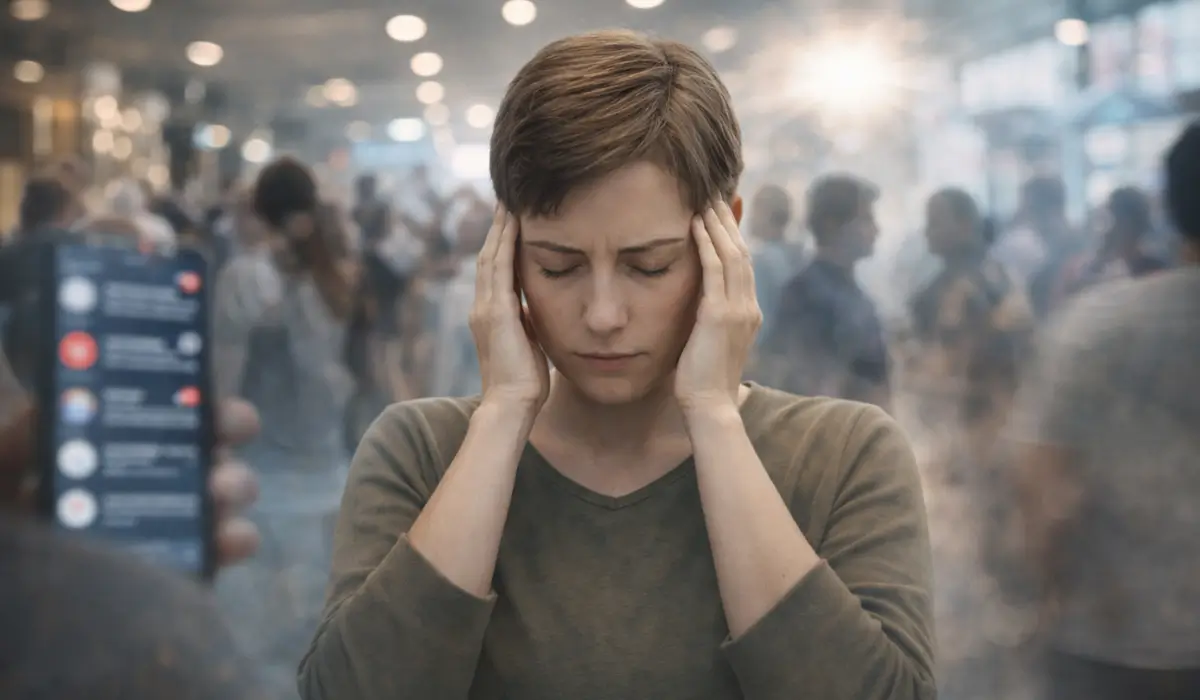
Emotional Regulation for Highly Sensitive People in an Overstimulated World
Yes—hypnosis can help Highly Sensitive People regulate overstimulation, reduce emotional reactivity, and strengthen nervous system balance without suppressing sensitivity.
You Feel Everything—and It’s Exhausting
As Highly Sensitive People, you experience life deeply. Sound carries weight. Social tension lingers. Subtle emotional shifts register immediately, and recovery takes longer because your nervous system processes more information.
Research by Dr. Elaine Aron estimates that 15–20% of the population shares this neurological trait, with brain imaging showing heightened activation in empathy and awareness centers. Sensitivity is not weakness. Exhaustion develops when regulation cannot keep pace with stimulation.
Strengthen your nervous system with Geauga Mind Body Hypnosis and preserve emotional depth without chronic depletion.
Why Do Highly Sensitive People Feel Overstimulated So Easily? Many people searching for HSP support ask: “Why am I exhausted after social events?” “Why do small stressors feel overwhelming?” “Why does it take me longer to recover emotionally?” Highly Sensitive People have heightened activation in brain regions linked to empathy, awareness, and sensory integration. This means: Emotional signals are processed deeply > Environmental input accumulates quickly > Recovery requires more nervous system recalibration Overstimulation is not weakness. It is a regulatory load issue. |
What It Means to Be a Highly Sensitive Person (HSP)
Highly Sensitive People demonstrate a measurable trait known as sensory processing sensitivity. This temperament, identified by psychologist Dr. Elaine Aron, reflects a nervous system that processes environmental and emotional information more deeply than average.
Depth of Processing
Information is analyzed thoroughly before response. Highly Sensitive People tend to reflect carefully, consider multiple angles, and integrate meaning at a deeper cognitive level. This increased processing often contributes to insight and strong decision quality.
Overstimulation Susceptibility
Layered sensory input accumulates quickly. Bright lights, background noise, crowded spaces, and multitasking demands can overwhelm the nervous system faster than in less sensitive individuals. Recovery may require intentional downtime.
Emotional Reactivity and Empathy
Emotional signals are felt strongly and integrated deeply. Heightened activation in brain regions associated with empathy, including the insula and mirror neuron systems, contributes to strong relational awareness.
Sensitivity to Subtleties
Minor environmental or interpersonal shifts are detected rapidly. Facial micro-expressions, tone changes, or subtle mood shifts are often perceived immediately.
Neuroimaging research confirms heightened activation in brain regions associated with attention and emotional integration among individuals with high sensory processing sensitivity.
Sensitivity is distinct from anxiety disorder, trauma history, or introversion. Many Highly Sensitive People function effectively in leadership, caregiving, and high-responsibility roles. Difficulty arises when environmental intensity exceeds regulatory capacity rather than from sensitivity itself.
The Physiological Cost of Chronic Overstimulation in Highly Sensitive People
Modern environments activate the autonomic nervous system repeatedly throughout the day. Constant notifications, artificial lighting, multitasking demands, and emotional exposure maintain sympathetic dominance.
When overstimulation occurs, the HPA axis activates. Cortisol and adrenaline increase. Heart rate accelerates. Muscles brace.
Short-term activation is adaptive. Chronic activation is destabilizing.
Sustained sympathetic dominance can influence:
- Heart rate variability (HRV)
- Digestive efficiency
- Sleep architecture
- Immune signaling
- Inflammatory markers such as IL-6
NIH-indexed research links prolonged stress activation to fatigue syndromes and reduced vagal tone.
Highly Sensitive People may require longer recovery windows because their nervous systems process more contextual information before returning to baseline. Emotional absorption prolongs physiological activation beyond the original event.
Without recalibration, sensitivity begins to feel heavy rather than meaningful. Structured approaches such as HSP hypnosis therapy focus on restoring parasympathetic balance and reducing subconscious threat signaling so recovery becomes more efficient rather than prolonged.
Regulation Without Emotional Shutdown Many Highly Sensitive People fear losing depth or empathy when seeking stress relief. Hypnosis does not suppress emotional range. Instead, it recalibrates subconscious threat interpretation so: > Recovery becomes faster > Emotional boundaries strengthen > Anticipatory anxiety decreases >Social fatigue shortens Sensitivity remains. Reactivity softens. |
How Hypnosis Helps Highly Sensitive People Regulate Without Suppression
The goal of hypnosis is regulation, not emotional shutdown.
Hypnosis for highly sensitive person patterns focuses on calming subconscious alarm responses that amplify stimulation. Hypnotic states are associated with increased theta brainwave activity—a frequency linked to memory reconsolidation and emotional recalibration.
Research suggests hypnosis may reduce anxiety intensity and alter stress perception pathways by influencing limbic system activity.
Amygdala Downregulation
Neuroimaging research shows decreased activity in the amygdala during hypnotic states. Since the amygdala drives threat detection and emotional reactivity, reduced activation lowers exaggerated alarm responses.
Strengthened Prefrontal Control
Connectivity between the prefrontal cortex and limbic regions improves during hypnosis. Stronger top-down regulation allows more measured emotional responses instead of reflexive reactions.
Parasympathetic Activation
Hypnosis increases parasympathetic dominance and supports vagal tone. Greater autonomic balance improves emotional regulation capacity and shortens recovery time after stimulation.
Reduced Hypervigilance
As subconscious threat interpretation softens, scanning for danger decreases. Internal steadiness replaces anticipatory tension.
Unlike meditation, which emphasizes observation without suggestion, hypnosis introduces guided reframing at the subconscious level. That distinction allows targeted recalibration of emotional responses rather than passive awareness alone.
Absorption and Hypnotic Responsiveness
Many Highly Sensitive People exhibit strong absorption — the capacity to focus deeply and visualize vividly. Research shows absorption correlates with hypnotic responsiveness, making structured hypnotic work particularly effective for this nervous system profile.
Review structured nervous system approaches within Holistic Hypnotherapy Services to understand how regulation is systematically developed.
Why Highly Sensitive People Often Respond Well to Hypnosis
Absorption—the capacity to become deeply immersed in mental imagery or experience—appears frequently in Highly Sensitive People.
That strength supports:
- Strong visualization
- Emotional insight
- Internal focus
- Rapid state-shifting capacity
Rather than suppressing sensitivity, hypnosis reorganizes subconscious threat interpretation patterns so emotional depth remains intact while reactivity decreases.

What Happens in a Hypnosis Session for Highly Sensitive People
Sessions remain calm, collaborative, and structured.
A typical session may include:
- Grounding exercises to stabilize physiology
- Breath pacing to improve vagal tone
- Guided imagery to establish internal safety
- Subconscious reframing of overstimulation triggers
- Emotional release for absorbed stress
Clients remain aware and in control throughout the process.
Sessions are paced carefully for sensitive nervous systems. There is no forceful confrontation. Emotional processing unfolds gradually.
When sensitivity overlaps with panic spikes or persistent alarm responses, additional stabilization techniques available within Anxiety Hypnosis Services can help retrain fear-based loops.
Holistic healing hypnotherapy integrates somatic awareness so regulation strengthens without dulling perception.
| What Clients Say After a Few Sessions Common reflections include: “I finally feel like I’m not crazy.” “I can be sensitive and calm.” “I still care deeply, but I’m not drained afterward.” Highly Sensitive People often describe emotional regulation as practical rather than theoretical. |
Being Sensitive Is a Gift — It Just Needs Stability for Highly Sensitive People
Highly Sensitive People carry depth that strengthens relationships and insight. Sensitivity becomes sustainable when paired with consistent regulation practices.
Evidence-supported grounding tools include:
🟢 Slow breathing at ~6 breaths per minute to improve HRV
🟢 Light reduction in evening hours to support melatonin rhythm
🟢 Emotional labeling to decrease amygdala reactivity
🟢 Scheduled decompression between stimulation blocks
🟢 Clear boundary language to reduce emotional absorption
Discussions on subconscious sensitivity and emotional resilience are shared regularly on the Podcast, offering grounded educational insight.
Frequently Asked Questions About Hypnosis for Highly Sensitive People Does hypnosis reduce emotional sensitivity? No. Hypnosis does not remove sensitivity. It helps regulate reactivity so emotional depth remains while overwhelm decreases. Is hypnosis safe for Highly Sensitive People? Yes. Hypnosis is a guided, focused state of attention. Clients remain aware and in control throughout the session. Why do HSPs often respond well to hypnosis? Highly Sensitive People often have strong absorption and visualization abilities. Research shows absorption correlates with hypnotic responsiveness. How many sessions are typically needed? Session frequency depends on stress history and goals. Some individuals notice regulation improvements within several sessions. Does hypnosis replace therapy or medical care? No. Hypnosis supports emotional regulation but does not diagnose or treat medical or psychiatric conditions. |
A Structured Path Forward for Highly Sensitive People
Sensitivity does not require correction. It requires calibration.
Strengthen nervous system stability with Geauga Mind Body Hypnosis and develop regulation without losing emotional depth.
Schedule a direct conversation by selecting Book a FREE consultation or speak with a professional when you Call 440-636-2029.
Calm does not erase depth. It allows Highly Sensitive People to carry it without exhaustion.
| This article was reviewed by Tiffani Cappello, CHt, NLP, CLC—a certified clinical hypnotherapist and mindset coach. With advanced training in subconscious reprogramming, anxiety recovery, and confidence-building, Tiffani ensures accuracy and clarity throughout. ➤ Meet our certified team to see how hypnotherapy encourages lasting calm and confidence. |
