
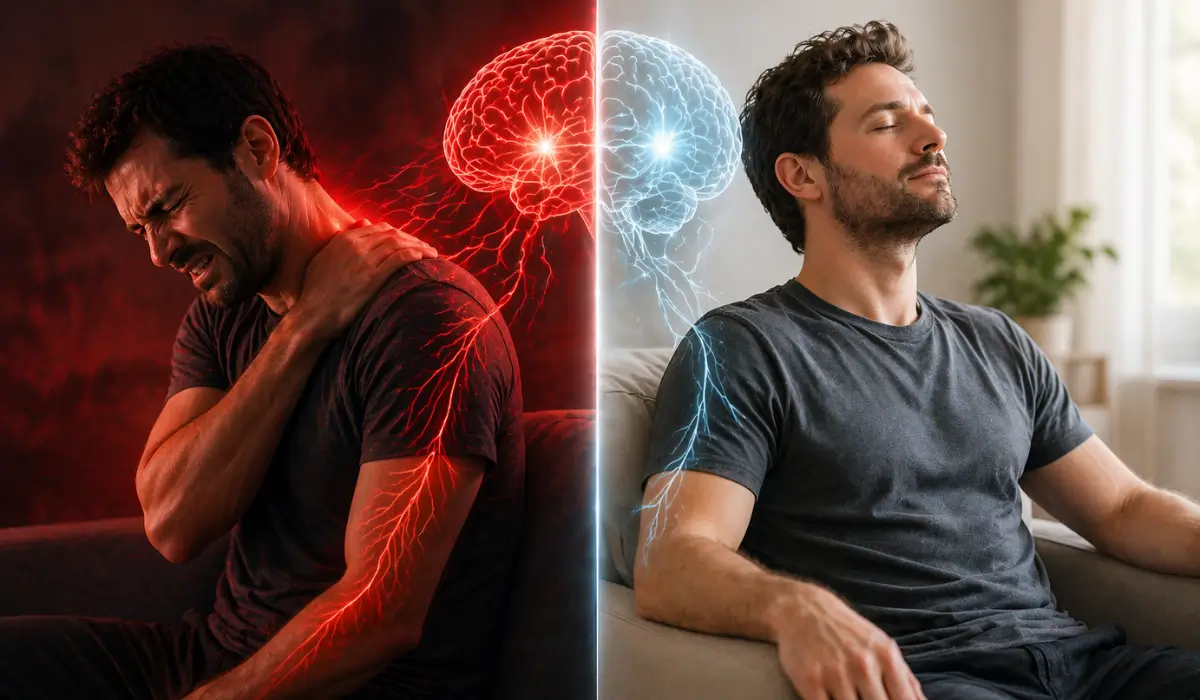
The Brain’s Role in How Pain Is Experienced
Pain Reprocessing Therapy is based on the understanding that chronic pain can continue even after the body has healed because the brain and nervous system have learned to stay in a protective, danger-oriented state. Over time, the brain can become conditioned to interpret normal sensations, stress, emotions, movement, or harmless signals as threats, which keeps the pain response active.
Rather than focusing only on the body itself, Pain Reprocessing Therapy works to retrain the brain’s interpretation of these signals. As the brain begins to recognize that the sensations are no longer dangerous, the nervous system can calm, fear around the pain decreases, and the pain pathways can gradually weaken and change. This process helps shift the brain out of chronic protection mode and back toward a state of safety and regulation.
When pain feels far more intense than what scans, tests, or medical findings can explain, it often creates deep confusion and frustration. Many people begin to feel trapped between very real physical symptoms and the absence of a clear structural cause. This can leave people feeling dismissed, hopeless, or as though no one fully understands what they are experiencing.
But the pain is real.
In many chronic pain conditions, the issue is not that the symptoms are imagined — it is that the brain and nervous system can become stuck in a heightened protective response, continuing to generate pain long after an injury has healed or in the absence of significant tissue damage.
GEAUGA MIND BODY HYPNOSIS we specialize in helping clients understand these patterns using mind body pain reprocessing, approaches, hypnotherapy, and brain-based retraining grounded in neuroplasticity, this forms the foundation pain and symptom reprocessing therapy.
Pain Signals vs Pain Perception
Pain signals may begin in the body, but the brain ultimately decides how much attention, urgency, and intensity those signals receive. The exact same physical sensation can feel mild one day and overwhelming the next depending on stress levels, emotional state, fear, attention, past experiences, and the brain’s interpretation of danger.
The sensation itself is often not the entire problem. The brain continuously evaluates incoming signals and assigns meaning to them based on memory, conditioning, previous pain experiences, and perceived threat. When the brain interprets a sensation as dangerous, it can increase vigilance, tension, fear, and pain amplification in an effort to protect the body.
Over time, many people notice that the cycle becomes less about the original sensation and more about the anticipation of what the sensation might mean. The nervous system becomes increasingly focused on monitoring, predicting, and reacting to pain. Clients often describe a pattern where the physical sensation remains relatively similar, yet their emotional and nervous system response grows stronger over time as the brain learns to expect danger.
| Component | Role |
|---|---|
| Signal | Information from the body |
| Interpretation | Determines threat level |
| Perception | Creates the pain experience |
When the brain changes the way it interprets a sensation, the pain response itself can begin to change. In many chronic pain conditions that are not being driven by ongoing structural damage or active disease, the brain and nervous system can become caught in a learned neural circuit pattern that continues generating pain even after healing has occurred. The pain is real, but the nervous system has become overprotective and hypersensitized.
Pain Reprocessing Therapy works to help retrain these neural pathways by reducing fear, changing the brain’s interpretation of bodily sensations, and helping the nervous system recognize safety again. As the brain stops treating normal sensations and movement as dangerous, the pain response can gradually decrease and, in some cases, resolve completely.
🩺 Medical Guidance
It is extremely important, however, that any pain or physical symptoms be thoroughly evaluated by a qualified healthcare professional before assuming they are related to a neural circuit disorder or mind-body condition. Persistent or severe symptoms should always receive appropriate medical assessment to rule out structural, neurological, inflammatory, infectious, or other medical causes.
Why Pain Is Both Physical and Neurological
Pain involves real signals from the body, but those signals are processed and interpreted through the brain and nervous system. This is why stress, fear, trauma, attention, emotional state, and previous pain experiences can all influence how intense pain feels and how long it persists.
Many people living with chronic pain are told that scans, imaging, or medical testing do not fully explain the severity of their symptoms, yet the pain continues to feel very real and disruptive. In some cases, the nervous system itself has become sensitized and stuck in an ongoing protective response, continuing to generate pain even after significant healing has occurred or when active structural damage is no longer present.
This pattern is commonly seen in neural circuit pain and other mind-body conditions where symptoms no longer match injury timelines, imaging findings, or the degree of physical pathology. The body may be relatively stable, yet the brain and nervous system continue reacting as though danger is still present, reinforcing the pain response over time.
It is extremely important to understand that pain generated or amplified by the brain and nervous system is not imaginary or “all in your head.” The pain is absolutely real.
The brain creates every pain experience a human being has ever felt, including pain from obvious physical injuries.
One of the clearest examples of this is phantom limb pain, where a person experiences severe pain in a foot, hand, arm, or leg that has been amputated and is no longer physically present. Even though the limb itself is gone, the brain and nervous system continue generating very real pain signals.
This demonstrates how powerfully the brain can create and maintain pain experiences independent of ongoing tissue damage or structural injury.
How the Brain Learns Chronic Pain
The brain and nervous system are constantly learning through repetition, experience, prediction, and conditioning. This is helpful when learning language, driving a car, or developing muscle memory, but the exact same learning process can also occur with pain.
When the brain repeatedly experiences pain alongside fear, stress, injury, emotional distress, hypervigilance, or danger signals, it can begin building strong neural pathways around that pain experience. Over time, the nervous system becomes increasingly efficient at producing the pain response. The brain essentially learns that certain movements, sensations, environments, emotions, or activities are dangerous and begins reacting automatically in an attempt to protect the body.
At first, pain may begin with a legitimate injury, illness, inflammation, or physical event. But after healing occurs, the nervous system does not always immediately return to normal. In some people, the brain remains stuck in a heightened protective state and continues sending danger and pain signals long after the original injury has stabilized or resolved.
This is why many people notice that pain begins spreading, shifting locations, worsening during stress, appearing without a clear physical trigger, or fluctuating dramatically from day to day. Many also notice that fear and attention toward the pain make symptoms intensify, while distraction, relaxation, safety, positive emotions, or feeling deeply engaged in life temporarily reduce symptoms. These patterns strongly suggest that the nervous system and brain are playing a major role in maintaining the pain cycle.
Over time, the brain can begin predicting pain before movement even occurs. A person bends over, walks up stairs, sits in a car, exercises, or wakes up in the morning, and the brain has already learned to expect danger. The nervous system then automatically generates real pain and tension responses based on those learned predictions. In this way, chronic pain can become a conditioned neural circuit pattern that continues repeating itself until the brain learns that the activity or sensation is no longer dangerous.
Neuroplasticity and Pain Pathways
The brain is highly adaptive and constantly changing based on repetition and experience, a process known as neuroplasticity. Neural pathways that are used repeatedly become stronger, faster, and more automatic over time. This is true for positive skills like learning an instrument or driving a car, but it can also occur with fear, anxiety, and chronic pain.
When a neural pain pathway is activated repeatedly, the brain becomes increasingly efficient at producing that pain response. The nervous system begins recognizing certain sensations, movements, emotions, environments, or stressors as familiar danger signals and reacts more quickly and intensely each time. Eventually, the pain response can become deeply conditioned and automatic, occurring with less and less input from the body itself.
Over time, the threshold for triggering pain may become lower and lower. A movement that once caused only mild discomfort may begin producing severe pain. Activities that were once safe may start triggering symptoms simply because the brain has learned to associate them with danger. In some cases, even anticipation, fear, or attention toward the pain becomes enough to activate the neural circuit.
This is one reason chronic pain often feels so confusing and unpredictable. The nervous system is no longer responding only to structural injury or tissue damage. Instead, the brain has learned a protective pain pattern that has become reinforced through repetition, fear, hypervigilance, stress, and expectation. The more frequently the pathway fires, the more sensitized and efficient it can become until the pain response begins occurring automatically.

This visual helps simplify how pain signals, prediction, and attention reinforce each other in the brain.
A Consistent Pattern Observed in Practice
1
Pain occurs repeatedly
2
The brain begins to expect it
3
Expectation activates the same pathway faster
4
The response becomes automatic
This is why chronic pain brain retraining approaches focus heavily on changing and calming the learned neural pathways that are maintaining the pain response rather than endlessly attempting to “fix” the body itself when significant structural pathology is no longer present. In many cases of neural circuit pain, the nervous system has become conditioned to continue producing pain automatically, even after healing has occurred.
Over time, the brain can stop accurately reevaluating whether a sensation is truly dangerous in the present moment. Instead, it begins relying on prediction. The nervous system learns to anticipate pain based on past experiences, fear, memory, hypervigilance, emotions, movement, stress, or previously painful situations. Once this predictive process becomes deeply conditioned, the brain can begin generating pain before an activity even occurs.
This creates what many chronic pain experts refer to as a learned pain loop. The brain predicts pain, attention becomes increasingly focused on the body, fear and vigilance rise, the nervous system becomes more activated, and the pain experience intensifies. That intensified experience then further reinforces the brain’s expectation that something is wrong, strengthening the neural pathway even more.
This is often the stage where people become convinced their body must still be severely damaged because the pain feels so intense, persistent, and real. Yet in many neural circuit conditions, the symptoms themselves are being maintained primarily by an overprotective, sensitized nervous system rather than ongoing tissue injury or progressive structural damage.
Why Repeated Pain Strengthens Neural Pathways
When pain is experienced repeatedly over long periods of time, especially alongside fear, stress, hypervigilance, or emotional distress, the brain can begin learning the pain response as a protective pattern. The nervous system starts associating certain sensations, movements, activities, emotions, or environments with danger and becomes increasingly efficient at producing pain in response.
Initially, pain may begin with a legitimate injury or physical problem. But over time, the brain can become so focused on monitoring and anticipating pain that the nervous system continues generating symptoms automatically, even after significant healing has occurred. The brain essentially learns to predict pain rather than simply responding to injury in real time.
At this stage, pain is no longer being driven entirely by tissue damage. Instead, the nervous system has become sensitized and overprotective. Certain movements, stressors, sensations, or even thoughts can begin triggering pain because the brain has learned to associate them with danger.
This is why many people notice strange or inconsistent pain patterns that do not fully match structural injury. Someone may experience severe back pain while sitting quietly yet notice the pain decreases when distracted, emotionally engaged, exercising, on vacation, or focused on something enjoyable. Others may notice headaches, neck pain, stomach symptoms, or body tension intensify during periods of stress and calm down when the nervous system feels safer and more regulated.
These patterns are not imaginary, exaggerated, or random. They often reflect a nervous system that has become conditioned to stay in a protective pain response. The symptoms are real, but the brain and nervous system have learned to continue generating pain signals long after the original danger has passed.
When Pain Persists After the Body Heals
One of the most confusing and frustrating aspects of chronic pain is that pain can continue long after the body has substantially healed. Many people assume that if pain is still present, there must still be ongoing injury or damage occurring inside the body. While this is sometimes true, it is not always the case.
In neural circuit pain and other chronic pain conditions, the brain and nervous system can continue producing pain even after tissues have healed and the original injury has stabilized. The nervous system essentially becomes stuck in a learned protective response. The brain continues sending danger signals because it has become conditioned to expect pain, monitor for pain, and react to certain sensations as threats.
This is similar to how someone can continue feeling anxious long after a stressful event has ended. The nervous system learns the pattern and keeps repeating it automatically. In chronic pain, the brain may continue activating pain pathways even when significant structural damage is no longer present.
This is why many chronic pain sufferers experience symptoms that fluctuate dramatically depending on stress, fear, emotional state, attention, environment, sleep, or nervous system activation. Symptoms may worsen during stressful periods and improve during moments of relaxation, distraction, safety, excitement, or emotional calm. These fluctuations often suggest that the nervous system itself is playing a major role in maintaining the pain response.
Importantly, this does not mean the pain is imagined or exaggerated. The pain is very real. It simply means the brain and nervous system have learned a chronic protective pattern that continues generating pain signals after healing has occurred.
Common situations where pain continues
Clients frequently describe:
- Back pain that remains despite normal scans
- Migraines without consistent triggers
- Fibromyalgia-like symptoms that shift or fluctuate
Another common pattern seen in neural circuit pain is symptoms that move, spread, or shift locations throughout the body without a clear structural explanation. A person may initially experience pain in the lower back, only to later develop neck pain, jaw pain, headaches, pelvic pain, stomach symptoms, or pain in completely different areas despite no new injury occurring.
This type of shifting symptom pattern often does not follow typical structural or anatomical injury patterns. Instead, it suggests that the nervous system itself has become sensitized and overprotective. The brain begins generating pain and danger signals in different areas as part of a learned neural response rather than from ongoing tissue damage in one isolated location.
Many people notice that as one symptom improves, another symptom suddenly appears somewhere else. This phenomenon is frequently observed in mind-body and neural circuit conditions and further supports the idea that the brain and nervous system are playing a central role in maintaining the pain response.
The FIT Criteria is a screening tool developed by chronic pain experts to help identify whether symptoms may fit the pattern of neural circuit pain or mind-body pain rather than ongoing structural injury or disease. The questionnaire looks for common characteristics frequently seen in chronic pain conditions driven by nervous system sensitization, learned pain pathways, and brain-based predictive pain responses.
The assessment asks questions about symptom patterns such as pain that moves around the body, symptoms that worsen during stress, pain that appears without clear injury progression, symptoms that fluctuate dramatically, or pain that improves during distraction, relaxation, vacation, or emotional safety. It also looks at whether medical testing fully explains the severity and persistence of the symptoms.
The FIT Criteria is not designed to diagnose a medical condition or replace proper medical evaluation. Instead, it helps people recognize whether their symptoms may fit the common presentation of neural circuit pain and whether further exploration of mind-body or pain reprocessing approaches may be appropriate.
To use the FIT Criteria, simply work through the questionnaire honestly and look for overall patterns rather than focusing on one individual symptom. The more strongly your symptom patterns match the characteristics described, the more likely it may be that the nervous system and brain are playing a significant role in maintaining the pain response.
Patterns That May Suggest Neural Circuit Pain
Certain symptom patterns are commonly seen in learned pain and nervous system sensitization conditions. While these patterns do not replace proper medical evaluation, they can sometimes suggest that the brain and nervous system are playing a significant role in maintaining the pain response.
✓
Symptom Checklist
Common patterns that may suggest nervous system sensitization or neural circuit pain:
✓
Symptoms that move, spread, or shift locations throughout the body
✓
Pain intensity that changes dramatically without a clear physical reason
✓
Symptoms that worsen during stress, fear, overwhelm, or emotional distress
✓
Pain responses triggered by movements, environments, times of day, or anticipation itself
✓
Pain that improves during distraction, relaxation, exercise, or emotional safety
✓
Symptoms that appear inconsistent with imaging findings or injury timelines
✓
Medical tests that fail to fully explain the severity or persistence of symptoms
✓
Symptoms that fluctuate unpredictably despite stable physical findings
These patterns do not diagnose a medical condition, but they may suggest the nervous system is playing a significant role in maintaining the pain response.
Many people experiencing these patterns undergo repeated testing, scans, treatments, and specialist evaluations while continuing to search for a structural explanation that fully accounts for the symptoms. The pain itself is absolutely real, but the way the symptoms behave often does not match typical tissue damage or progressive injury patterns.
For many chronic pain sufferers, this disconnect becomes the turning point that leads them to explore neural circuit pain, pain reprocessing therapy, and brain retraining approaches as a more accurate explanation for what may be happening within the nervous system.
What Pain Reprocessing Therapy Does Differently
Traditional approaches to chronic pain often focus entirely on managing symptoms, avoiding triggers, protecting the body, or searching endlessly for structural explanations. Pain Reprocessing Therapy takes a different approach. Instead of viewing the pain solely as a sign of ongoing damage, it works from the understanding that the brain and nervous system can sometimes become stuck in a learned danger response that continues generating pain even after healing has occurred.
Rather than fighting the body or attempting to suppress symptoms, the goal becomes helping the brain reinterpret sensations more accurately and reducing the nervous system’s perception of danger. The brain is constantly scanning the body and environment, asking one central question: “Am I safe or am I in danger?” When the brain repeatedly interprets normal sensations, movement, stress, or physical feelings as dangerous, it amplifies pain as a protective response.
Pain Reprocessing Therapy works to interrupt this cycle by helping the nervous system experience sensations with less fear, less catastrophic interpretation, and less hypervigilance. As the brain gradually learns that certain sensations are not actually dangerous, the nervous system can begin calming down and the pain amplification process often starts decreasing naturally.
In real-world chronic pain recovery, this is frequently where meaningful change begins. Once the brain no longer interprets a sensation as threatening, many people notice that the pain loses intensity, urgency, and emotional charge without forcing the body itself to change.
Clients commonly report experiences such as:
- Reduced fear and urgency surrounding symptoms
- Less obsessive monitoring of the body
- Decreased hypervigilance toward sensations
- Lower perceived pain intensity
- Increased ability to move, function, and engage in life normally
- Symptoms becoming less dominant in daily thinking
The shift often occurs when the nervous system stops treating the sensation as a threat that requires protection. As safety increases within the brain and body, the learned pain pathways can gradually weaken over time.
Building New Neural Pathways
One of the most hopeful aspects of neural circuit pain recovery is that the same brain and nervous system that learned the pain response can also learn safety. Because the brain is capable of neuroplastic change throughout life, new neural pathways can gradually develop when healthier patterns are repeated consistently over time.
As the nervous system repeatedly experiences safety instead of danger, the old pain pathways begin weakening while new, calmer patterns become stronger. The brain slowly stops predicting pain automatically and becomes less reactive to sensations, movement, stress, and previously conditioned triggers.
In practice, this process often involves:
- Responding to symptoms with less fear and urgency
- Reducing hypervigilance and obsessive body monitoring
- Repeating calm, safety-based responses consistently
- Re-engaging with movement and life activities gradually
- Teaching the nervous system that sensations are not dangerous
- Reinforcing new patterns until they become more automatic than the old pain response
Over time, consistency helps shift the nervous system’s baseline away from chronic protection and toward greater regulation and safety.
When working with chronic pain clients, Tiffani Cappello utilizes Pain Reprocessing Therapy (PRT), a highly effective evidence-based approach designed to help retrain the brain and nervous system out of chronic pain patterns. Tiffani was trained by Dr. Howard Schubiner, one of the leading pioneers in the field of neural circuit pain and Pain Reprocessing Therapy.
In addition to Pain Reprocessing Therapy techniques, Tiffani also incorporates her own unique approach using Transformational Hypnosis and subconscious reprogramming methods. This allows clients to work not only with conscious nervous system retraining, but also with the deeper subconscious beliefs, fear patterns, emotional conditioning, stress responses, and protective programming that may be reinforcing the chronic pain cycle. By combining nervous system retraining with subconscious transformation work, many clients experience a deeper and more comprehensive shift in how the brain and body respond to pain.
How Mind-Body Healing Supports Recovery
Reducing fear fundamentally changes how the brain and nervous system respond to pain signals. When the brain perceives a sensation as dangerous, it increases attention, hypervigilance, muscle tension, stress activation, and pain amplification in an effort to protect the body. But when the brain begins recognizing that the sensation is not actually threatening, the nervous system can gradually stop reacting with the same intensity.
This is one of the central principles behind Pain Reprocessing Therapy. The goal is not to convince someone the pain is imaginary, but to help the brain reinterpret certain chronic sensations as safe rather than dangerous. As fear decreases and the nervous system becomes less reactive, the amplification process often begins calming down naturally.
Over time, the brain learns that the sensation does not require an emergency response. The nervous system becomes less sensitized, the learned pain pathways begin weakening, and people can experience a reduction in pain intensity, fear, and symptom preoccupation as the brain shifts out of chronic protection mode.
Research from the National Institute of Neurological Disorders and Stroke has shown that the brain is capable of neuroplasticity, meaning it can change, adapt, and form new neural pathways throughout life. This ability to rewire and reorganize supports the understanding that chronic pain patterns and learned pain responses within the nervous system can also be retrained over time.
Breaking the pain cycle
In many forms of neural circuit pain, the nervous system becomes trapped in a repeating cycle that reinforces symptoms over time. The process often follows a predictable pattern:
- A physical sensation appears
- The brain interprets the sensation as dangerous
- Fear, monitoring, and hypervigilance increase
- The nervous system amplifies the sensation
- Increased pain creates even more fear and attention
- The brain further reinforces the pain pathway
Over time, this cycle can become automatic. The brain begins predicting danger and activating pain responses before consciously evaluating whether the sensation is actually harmful.
One of the central goals of Pain Reprocessing Therapy is to interrupt this learned fear-pain loop and help the nervous system respond differently. As the brain begins recognizing that certain chronic sensations are not dangerous, the cycle can gradually begin shifting:
- Understanding reduces perceived danger
- Reduced danger decreases fear and hypervigilance
- Less monitoring lowers nervous system activation
- Lower activation reduces pain amplification
- Reduced intensity weakens the learned neural pathway over time
As the brain repeatedly experiences sensations without reacting with fear and alarm, the nervous system can gradually move out of chronic protection mode and into a more regulated state.
For individuals who also experience panic attacks, panic symptoms, or severe nervous system sensitization alongside chronic pain — which is extremely common — additional nervous system retraining approaches may also be helpful. Tiffani Cappello often incorporates her Panic2Calm™ method when panic and chronic pain coexist, helping clients break the fear-driven nervous system cycles that can intensify both pain and anxiety responses.
When to Consider Additional Support
When chronic pain continues despite extensive medical evaluations, treatments, physical therapies, medications, or repeated attempts to “fix” the body, many people begin feeling trapped, discouraged, and exhausted. In some cases, the problem is not that something dangerous is being missed. The problem may be that the nervous system and brain are continuing to generate pain through a learned neural circuit response that is being misunderstood as ongoing damage.
This is especially important when symptoms fluctuate dramatically, move throughout the body, intensify during stress, improve during distraction or relaxation, or persist despite normal imaging and healing timelines. These patterns can sometimes suggest that the nervous system itself has become sensitized and stuck in chronic protection mode.
Research published in JAMA Psychiatry on Pain Reprocessing Therapy on Pain Reprocessing Therapy has demonstrated that helping the brain reinterpret chronic pain signals differently can significantly reduce symptoms in many chronic pain sufferers. This growing body of research supports the understanding that the brain and nervous system play a central role in maintaining many chronic pain conditions.
Recognizing when it may be time to shift the approach from exclusively searching for structural damage toward nervous system retraining and neural pathway change can become a major turning point in the recovery process. For many people, understanding what the brain and nervous system are actually doing is the first step toward breaking the chronic pain cycle.
Take the Next Step
When chronic pain continues despite normal tests, extensive treatments, or a lack of clear structural findings, it may be time to explore whether the nervous system itself has become stuck in a learned pain pattern. Continuing to search endlessly for structural explanations can sometimes keep people trapped in fear, hypervigilance, and frustration while the nervous system remains in chronic protection mode.
Pain Reprocessing Therapy and nervous system retraining approaches are designed to help the brain reinterpret chronic pain signals, reduce fear-based amplification, and calm the learned neural pathways that may be maintaining persistent symptoms.
Tiffani Cappello combines Pain Reprocessing Therapy techniques with Transformational Hypnosis and subconscious retraining approaches to help clients address chronic pain, nervous system sensitization, fear responses, and symptom-focused hypervigilance on a deeper level.
Discuss your symptoms, review whether your pain patterns may fit neural circuit pain, and learn whether this approach may be appropriate for your situation.
Medical Disclaimer
Tiffani Cappello is a clinical hypnotist and nervous system retraining practitioner, not a licensed physician or medical doctor. Transformational Hypnosis, Pain Reprocessing Therapy techniques, and subconscious retraining approaches are intended to support nervous system regulation alongside appropriate medical care, not replace it.
Individuals experiencing chronic pain or physical symptoms should work closely with qualified healthcare professionals and complete appropriate medical evaluation, testing, imaging, and diagnostic assessment before assuming symptoms are related to neural circuit pain or mind-body conditions.
Clients are encouraged to remain under the care of their physician and follow all medical recommendations. Hypnosis and nervous system retraining approaches are used as complementary tools designed to help address fear, stress, nervous system sensitization, learned pain responses, and subconscious protective patterns after appropriate medical evaluation.
| This article was reviewed by Tiffani Cappello, CHt, NLP, CLC—a certified clinical hypnotherapist and mindset coach. With advanced training in subconscious reprogramming, anxiety recovery, and confidence-building, Tiffani ensures accuracy and clarity throughout. ➤ Meet our certified team to see how hypnotherapy encourages lasting calm and confidence. |
