
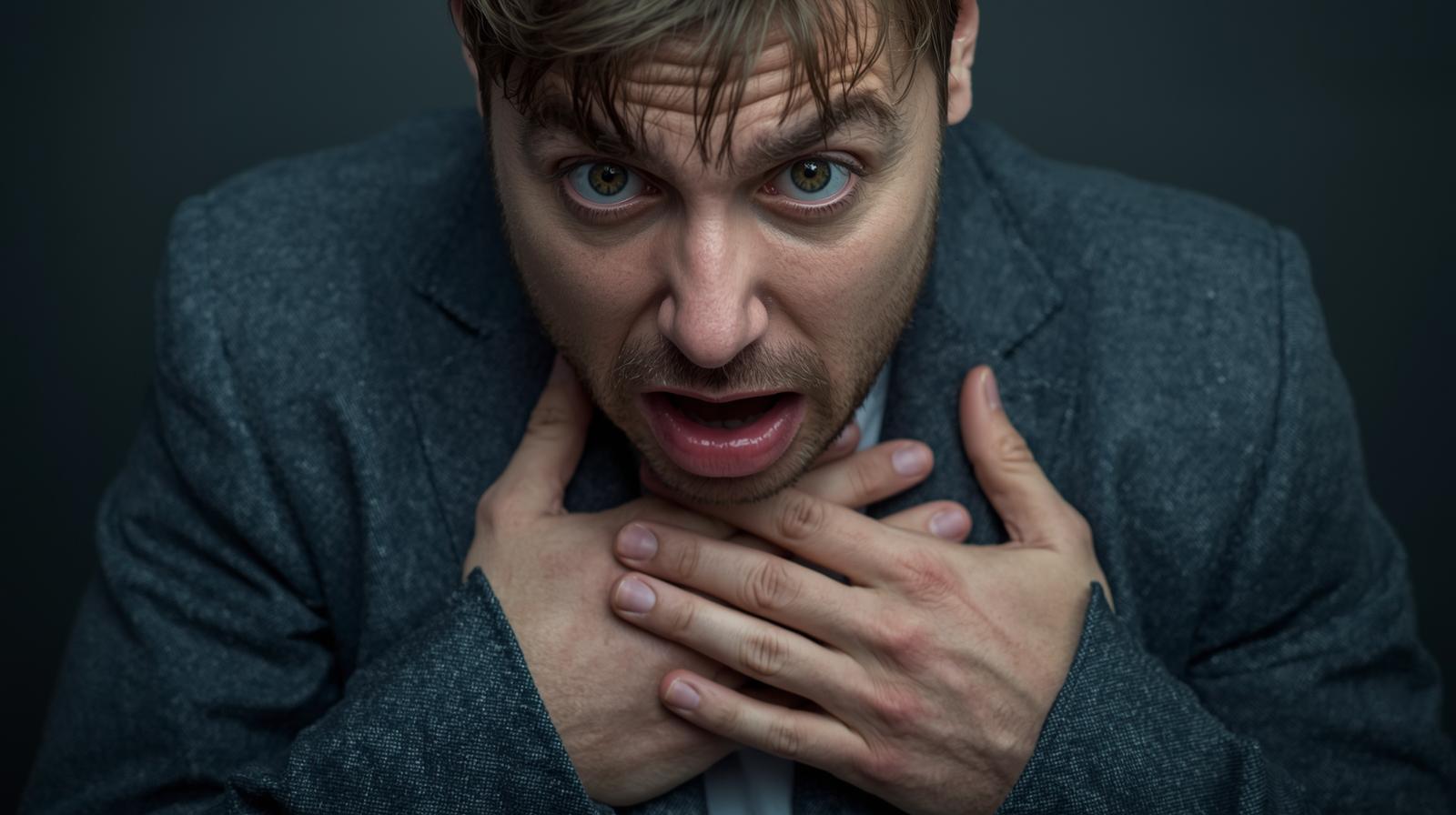
If you are asking yourself, “Am I having a panic attack or am I dying?” you are not dramatic, weak, or overreacting. You are terrified — and for good reason. This is actually one of the most common questions people have about panic attacks.
Panic attacks are designed by the nervous system to feel urgent, overwhelming, and life-threatening. In those moments, it feels impossible to believe that nothing serious is happening because everything in your body is signaling that something is very wrong. Your heart may be racing or pounding. Your chest may feel tight or painful. Your breathing may feel restricted or shallow. You may feel dizzy, nauseated, shaky, or detached from reality. A sudden wave of dread may surge through you, accompanied by the intense thought: This is it. Something catastrophic is happening.
It feels like a medical emergency.
This is why so many people experiencing a panic attack search phrases such as “panic attack vs heart attack,” “how to tell if I’m dying or having anxiety,” or “can panic attacks kill you.” The fear is real. The physical sensations are real. And the confusion is understandable.
I understand this fear deeply. I am not writing to you from a place of theory or distance. I am writing as someone who lived inside a severe panic disorder — someone who knows exactly what it is like to lie awake listening to your heartbeat, scanning your body for danger, wondering if this time is different. I know what it is like to question your safety, your sanity, and your future while desperately wanting relief.
That lived experience, combined with my medical background in physical therapy and my extensive training in Transformational Hypnosis, is what led me to develop the Panic2Calm™ method. Panic2Calm™ exists because panic is terrifying — and because it is also completely changeable.
Why Panic Attacks Feel Like a Medical Emergency
One of the most cruel aspects of panic attacks is how physical they feel. Many people assume anxiety is primarily mental. Panic attacks quickly prove otherwise.
Common panic attack symptoms include:
- Racing or pounding heart
- Chest tightness or chest pain
- Shortness of breath
- Dizziness or lightheadedness
- Nausea
- Shaking or trembling
- Tingling in the hands, arms, or face
- Sweating
- A sudden sense of impending doom
These sensations are not imagined. They are real physiological responses created by your nervous system. Panic activates the same fight-or-flight survival circuitry that would turn on if you were in immediate danger. Your brain believes it needs to protect you, and your body responds instantly by releasing adrenaline and stress hormones.
Heart rate increases to prepare for action. Breathing shifts to bring in more oxygen. Muscles tense. Blood flow redistributes. Sensory awareness sharpens.
The problem is not that your body is malfunctioning. The problem is that your brain has misidentified a threat.
The body does not distinguish between a real external threat and a perceived internal one. Once the alarm is triggered, everything ramps up rapidly. That is why panic attacks feel so convincing. The survival response is powerful by design.
Why Reassurance Never Seems to Stick
Many people experiencing panic attacks seek reassurance repeatedly. They may visit emergency rooms, urgent care centers, cardiologists, or primary care physicians. They undergo EKGs, blood tests, imaging scans, and cardiac evaluations. The results come back normal. They are told their heart is healthy. Their lungs are functioning properly. Nothing dangerous is happening.
Yet the panic continues.
This often leads to confusion and despair. If nothing is medically wrong, why does it feel so intense? Why does the fear return, sometimes stronger than before?
The reason is simple but rarely explained clearly: panic is not caused by a lack of reassurance. Panic is maintained by a subconscious fear loop.
The nervous system does not operate primarily on logic. It operates on learned patterns and associations. Once the brain learns to associate certain sensations — such as a racing heart or dizziness — with danger, reassurance alone cannot override that response. The alarm fires automatically, often before rational thought has a chance to intervene.
You can intellectually understand that you are safe and still experience a full panic attack. That disconnect is one of the most frustrating aspects of panic disorder.
The Real Fear Underneath “Am I Dying?”
For most people, the deepest fear during a panic attack is not actually death itself. It is loss of control.
It is the fear that something inside the body has gone wrong and cannot be stopped.
Thoughts may race:
What if this is a heart attack?
What if I pass out?
What if no one helps me in time?
What if this never stops?
These thoughts are not signs of weakness. They are the brain doing exactly what it was designed to do — scanning for threats and trying to keep you alive. The problem is not that your brain is malfunctioning. The problem is that it has misidentified the threat.
Instead of protecting you from external danger, it is reacting to internal sensations that are uncomfortable but not dangerous.
How This Question Keeps the Panic Cycle Alive
Every time the mind asks, “Am I dying?” it reinforces the belief that the sensations are dangerous. That belief fuels the release of adrenaline. Adrenaline intensifies the physical sensations. The intensified sensations increase fear. And the cycle continues.
Sensation leads to fear.
Fear leads to adrenaline.
Adrenaline leads to more sensation.
Over time, the panic itself becomes the thing you fear most. This is how panic attacks can begin to occur “out of nowhere.” It is why they can return even during calm periods of life. It is why people can feel trapped in constant vigilance, monitoring their body and waiting for the next episode.
This process is not weakness. It is conditioning.
Panic Does Not Mean Something Is Wrong With You
One of the most important truths to understand is this: panic does not mean your nervous system is broken. It does not mean you are weak, damaged, or incapable of handling life.
Panic is a learned response.
Your nervous system learned — often very quickly — that certain sensations were dangerous. Once that association formed, it began reacting automatically in an attempt to protect you. From the brain’s perspective, it is doing its job.
And here is the most hopeful part: what is learned can be unlearned.
The brain is adaptable. Neural pathways can change. The subconscious associations that fuel panic attacks can be retrained.
Why Panic Can Stop Completely
Panic does not resolve by fighting symptoms, avoiding sensations, constantly monitoring your body, or repeatedly seeking reassurance. Those strategies often keep the fear loop active because they reinforce the belief that the sensations are dangerous.
Panic stops when the subconscious fear response is interrupted and retrained.
This is the foundation of the Panic2Calm™ method.
Panic2Calm™ is an educational process that teaches people exactly how panic works in the brain and nervous system. When someone truly understands what is happening physiologically — and why — the sensations begin to lose their threat value. The nervous system no longer needs to sound the alarm.
The method also includes a subconscious reprogramming component because panic is not maintained at the conscious level. It is maintained in automatic patterns below awareness. When those patterns change, panic attacks stop occurring.
Not because you suppress them.
Not because you distract yourself.
But because the brain no longer perceives danger.
Why This Approach Feels Empowering Instead of Overwhelming
One of the most painful aspects of panic disorder is the feeling of helplessness. Many people feel at the mercy of their body, afraid of when the next panic attack might strike. They may avoid driving, traveling, exercising, or even being alone.
Panic2Calm™ is designed to reverse that experience.
Clients are not being “fixed.” They are not being controlled. They are being educated about how their nervous system works and taught how to interrupt the fear loop when it begins. This understanding alone is profoundly calming.
When the belief that the sensations are dangerous begins to shift, the panic response loses its fuel. Many people experience significant relief quickly because the nervous system no longer needs to remain on high alert.
Knowledge becomes power.
Understanding becomes regulation.
And regulation becomes freedom.
A Skill You Can Use for the Rest of Your Life
Panic2Calm™ is not about managing panic forever. It is about learning a skill that permanently changes how your nervous system responds to internal sensations.
This is not about willpower.
It is not about positive thinking.
It is not about forcing yourself to “calm down.”
It is about changing the way the brain interprets physical sensations and retraining the subconscious fear response that drives panic attacks.
Once the panic cycle is broken, it does not need to return. The question “Am I dying?” gradually disappears because the nervous system no longer perceives threat.
The power to stop panic was always inside you. You were never missing anything. You were never broken. You simply were not given the right explanation.
If You Are Living With This Fear, You Are Not Alone
If you are reading this while terrified, exhausted, or discouraged, please know this: I see you. I understand you. I know how real this feels. And I also know that panic attacks do not have to control your life.
There is a way out of the panic cycle — one grounded in education, compassion, and empowerment. When you understand how panic works, when you retrain the subconscious fear loop, and when your nervous system learns that you are safe, the urgency begins to fade.
Panic attacks feel life-threatening.
But they are not.
And once that truth becomes integrated at the deepest level of the nervous system, the fear that once dominated your life can dissolve completely. Schedule a free consult to learn more.
