
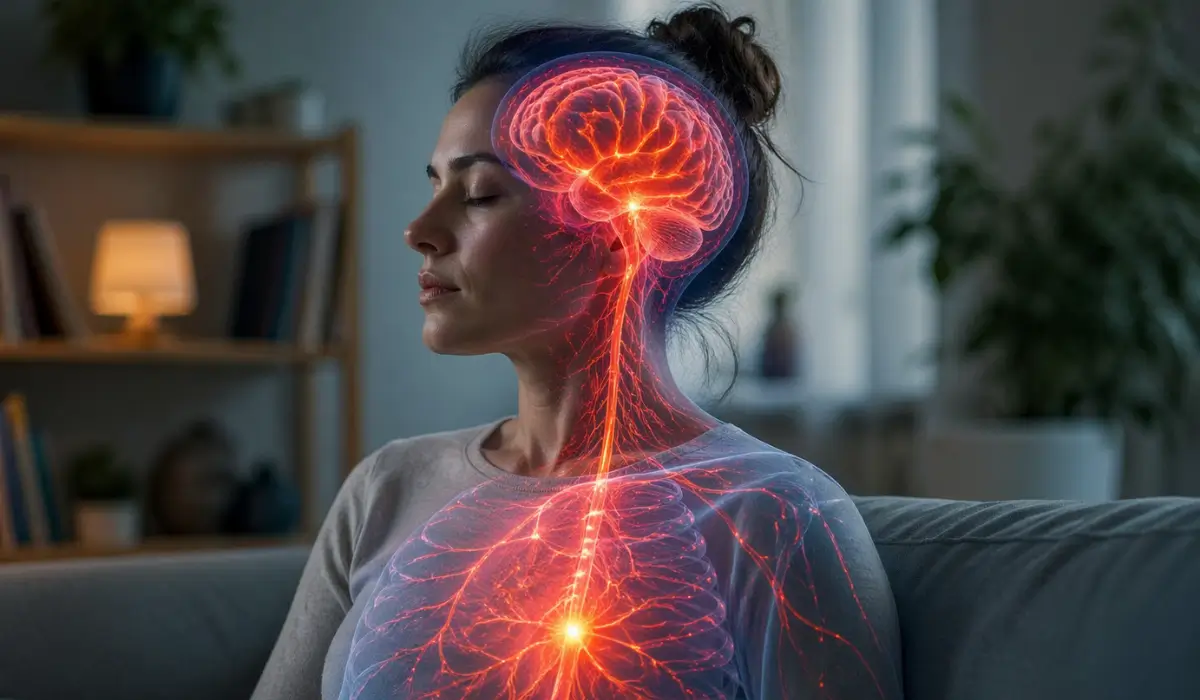
Anxiety does not go away just because you understand it or try to manage it. The brain learns to react automatically, even when there is no real danger. That is why the stress reaction continues and why changing the underlying learned pattern matters more than controlling it.
For many people, the frustration is not understanding anxiety—it’s feeling it happen anyway. That is often the point where hypnosis for anxiety starts becoming relevant, especially when the body continues reacting despite reassurance, coping tools, or conscious effort.
Many clients come in after trying therapy, breathing exercises, or lifestyle changes with only partial relief. They understand what anxiety is. They know they are safe—and the stress reaction still activates.
That points to something deeper than stress alone.
This is not a lack of effort. The reaction is happening at a level that logic does not control.
GEAUGA MIND BODY HYPNOSIS works with people who experience this exact challenge.
You can be sitting in a calm environment and still feel your body react as if something is wrong:
- your chest tightens
- your heart rate rises
- your thoughts accelerate
Nothing is wrong in that moment. The body reacts anyway.
These reactions feel intense, but they are functional. They are not dangerous.
That does not mean anything is wrong with you.
It means the reaction has been learned over time.
This process is explained further in our hypnosis services overview.
The feeling is real, but it is driven by learned patterns, not current danger.
Why the Brain Keeps Reacting Even When You Feel Safe
Anxiety continues even when you feel safe because the brain has learned to expect danger. The nervous system reacts automatically based on past reinforcement, not present conditions, which keeps the body on alert until that expectation is updated.
The Brain’s Threat System Activates First
The brain is designed to protect quickly, not evaluate accurately. This means the nervous system activates before logic can assess what is happening.
The American Psychological Association explains how anxiety involves rapid nervous system activation affecting both physical and mental responses.
The body reacts first.
The mind explains it after.
When the Brain Starts Expecting Danger
Repeated stress trains the brain to anticipate problems. Over time, that expectation becomes automatic and begins driving reactions in neutral situations.
Common patterns include:
- anxiety without clear triggers
- sudden waves of fear in ordinary environments
- avoidance of safe situations
- constant monitoring of body sensations
That expectation keeps the nervous system on alert.
The brain is not asking if something is wrong.
It is assuming something might be.
Why Logic Does Not Stop the Reaction
Logic does not stop anxiety because the reaction begins in the body before conscious thinking can respond. The nervous system activates automatically, so understanding the situation does not immediately change how the body responds.
Two Systems Operating at the Same Time
The thinking brain and the survival system operate separately. The body responds first, and thoughts follow to interpret the sensation.
The Cleveland Clinic explains how anxiety affects both physical sensations and cognitive processing.
Clients often describe it clearly:
“I know I am safe, but it does not feel that way.”
That disconnect reflects two systems operating at once.
The Anxiety Reaction Loop
The experience becomes self-reinforcing through repetition. Each episode strengthens the brain’s expectation, making future reactions more likely even without a real threat.
This is the Anxiety Reaction Loop:
- A sensation appears
- It is interpreted as a threat
- Fear increases
- The body amplifies the sensation
- The brain stores it as a warning
The sensation itself is not the problem. The meaning attached to it drives the cycle.
This is where most explanations stop—but the pattern becomes clear when you see it.
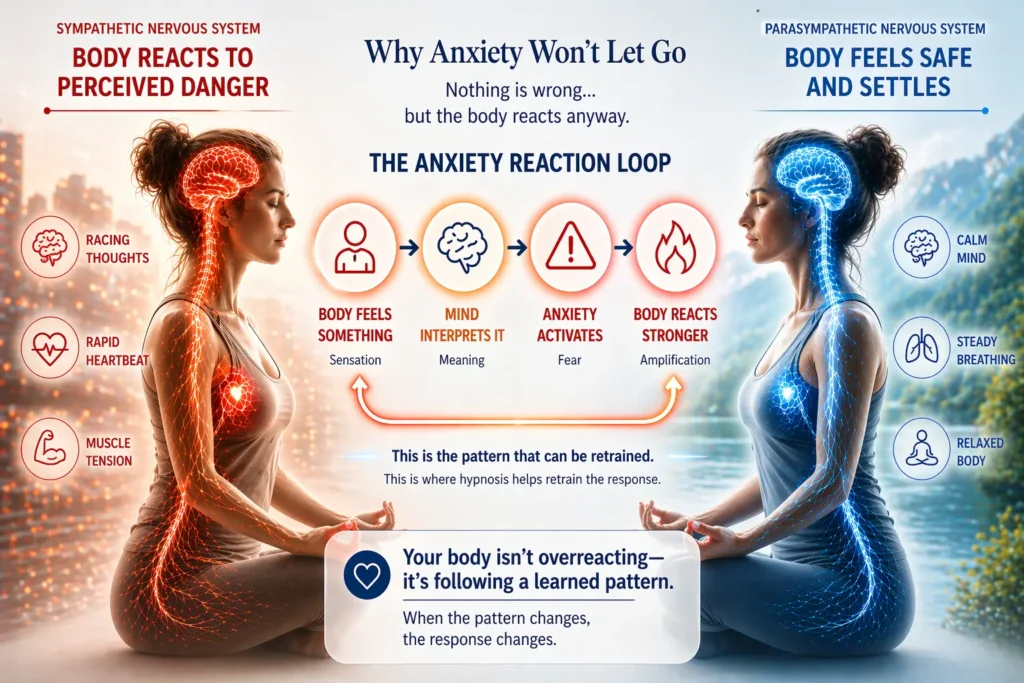
Once you understand this loop, it becomes clear why deeper approaches like hypnosis are effective—because the response isn’t being driven by logic, it’s being driven by learned patterns at a subconscious level.
How Hypnosis Helps Reach the Level Where the Pattern Exists
Hypnosis helps anxiety by working directly with the part of the brain that stores learned patterns. This is where hypnosis for anxiety becomes especially relevant, because it focuses on changing how the nervous system interprets sensations.
What Happens During Hypnosis
Hypnosis creates a focused state where the mind becomes more receptive to change. This allows the nervous system reaction to be addressed directly.
A structured hypnotherapy consultation session helps identify how the current cycle is operating.
Clients often notice the reaction begins before conscious thought. That gap is where the learned pattern becomes reinforced.
Why the Reaction Can Change
Learned patterns are built through repetition. They can also be updated through repetition when the nervous system learns that sensations are not dangerous.
In practice, this includes:
- reducing fear attached to sensations
- changing interpretation of physical signals
- reinforcing calm reactions consistently
The changes created through hypnosis are meant to be lasting because they work at the subconscious level where these patterns are stored. Some clients later choose hypnotic success coaching for separate goals such as confidence, career performance, relationships, or personal growth.
In some cases, working with a transformational coach strengthens behavioral reinforcement alongside subconscious retraining.
The sensation itself is not dangerous. The fear attached to it keeps the cycle active.
When a Pattern-Based Approach Becomes Relevant
A pattern-based approach becomes relevant when anxiety continues without clear triggers or improves only temporarily. This is where hypnosis for anxiety becomes a practical option because it works with how the nervous system has learned to respond.
Situations Where This Approach Is Considered
People often begin exploring deeper work when:
- anxiety persists despite therapy
- panic occurs without clear cause
- physical symptoms remain after medical reassurance
- daily life becomes restricted by avoidance
Programs like the Panic2Calm program or pain reprocessing therapy support help retrain these responses directly.
How Structured Work Supports Long-Term Change
Long-term change happens through consistent repetition that teaches the brain new responses. The nervous system updates its expectations over time, which is why structured approaches are more effective than isolated techniques.
What Structured Work Looks Like
A structured approach such as the 30-day transformation program helps shift the original anxiety patterns. The changes created through hypnosis are intended to be lasting. After anxiety improves, many people become interested in learning how subconscious techniques can also support confidence, career success, relationships, and personal growth through the long-term transformation membership.
Frequently Asked Questions About Hypnosis for Anxiety
Use these questions as a decision framework before moving forward.
Can hypnosis stop anxiety permanently?
Hypnosis focuses on the underlying cycle creating the anxiety. When the nervous system no longer treats sensations as dangerous, reactions naturally decrease.
Is hypnosis safe for anxiety treatment?
After medical causes are ruled out, hypnosis is considered safe when guided by a trained practitioner.
How many sessions are typically needed?
This depends on how long the learned pattern has been reinforced. Structured work tends to produce more stable results.
Generally, One 30 day transformation package
Why Anxiety Changes When the Cycle Changes
Persistent anxiety is not a failure. It reflects a learned response that continues until the brain updates what it expects.
When the expectation of danger changes, the reaction changes with it.
GEAUGA MIND BODY HYPNOSIS focuses on helping clients understand why the experience feels real, why it is not dangerous, and how to retrain it.
As that shift happens, the body settles. The mind follows.
Talk Through What May Be Driving Your Anxiety Response
Understanding your specific cycle is the first step toward changing it.
Book a FREE consultation to understand your response
| This article was reviewed by Tiffani Cappello, CHt, NLP, CLC—a certified clinical hypnotherapist and mindset coach. With advanced training in subconscious reprogramming, anxiety recovery, and confidence-building, Tiffani ensures accuracy and clarity throughout. ➤ Meet our certified team to see how hypnotherapy encourages lasting calm and confidence. |
