
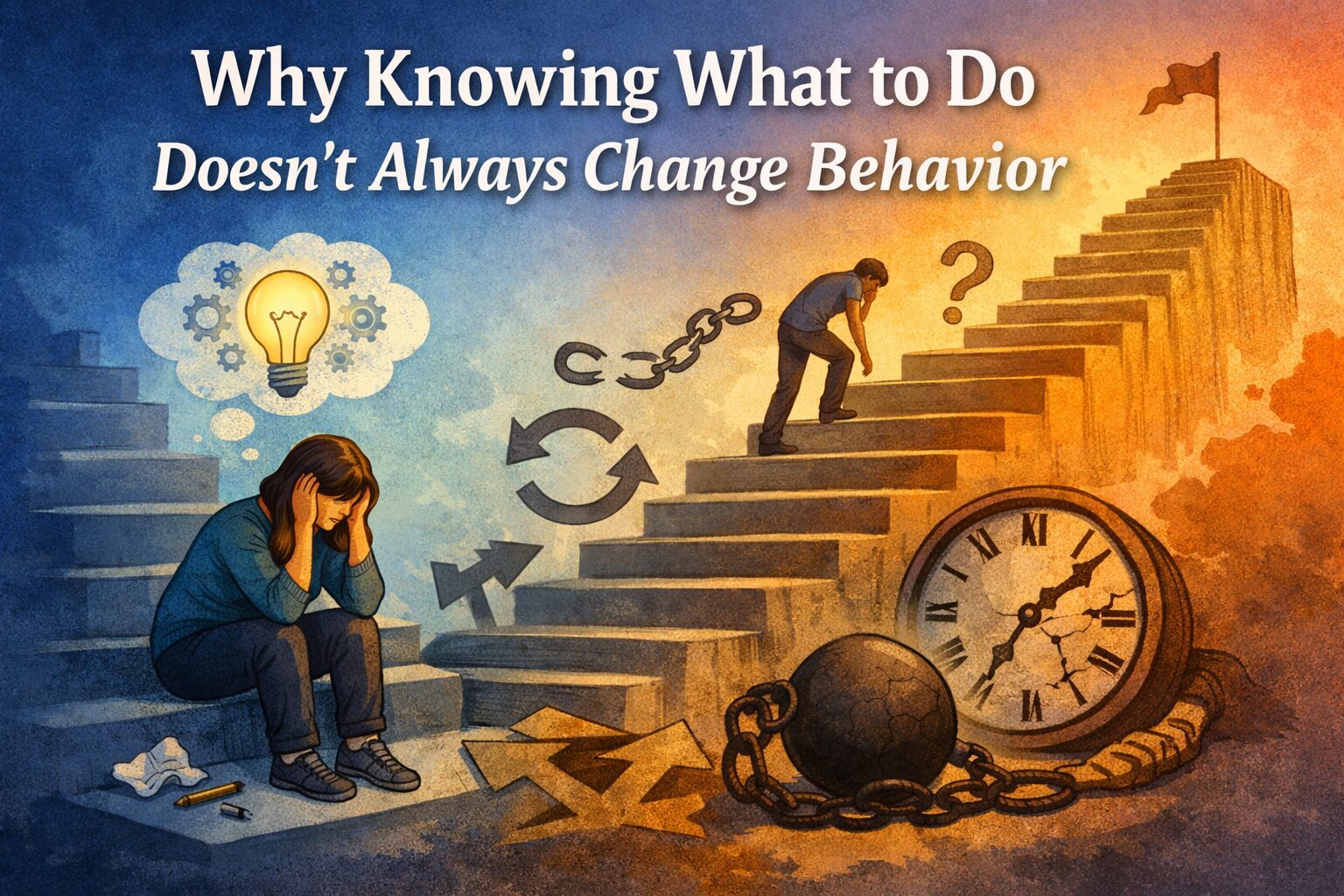
Have you ever found yourself wondering why certain behaviors continue even when you clearly understand that they are not helping you? Many people experience the strange frustration of knowing exactly what they should do, yet repeatedly finding themselves making a different choice in the moment. Someone may understand the importance of regular exercise and genuinely want to build a healthier routine, yet day after day they postpone starting. Another person may promise themselves that they will stop checking their phone late at night, only to realize that an hour has passed while they mindlessly scroll through messages or social media. Others may recognize that a relationship is unhealthy or emotionally draining, yet they remain in the same dynamic far longer than they intended.
Few experiences are more confusing than understanding the right path and still feeling unable to follow it. Thoughtful, intelligent people often read books about personal development, reflect deeply on their habits, and develop clear insight into their patterns. They may understand exactly where their behaviors began and why they continue, yet despite this awareness the same reactions, habits, and choices keep appearing in their lives. Over time a painful question often begins to surface: if the problem is so clear, why does it still feel so difficult to change?
The answer frequently lies in the difference between conscious understanding and subconscious programming. Much of human behavior is not driven by careful reasoning or deliberate decision making. Instead, a large portion of our daily reactions are shaped by patterns that the brain learned long ago through experience, repetition, and emotional conditioning. These patterns gradually become automatic responses that the nervous system activates without requiring conscious thought.
The Gap Between Knowing and Doing
Human behavior is far more complex than simple logic or self discipline. Although we often imagine that our choices are guided primarily by rational thinking, the brain actually relies heavily on automatic processes that operate much faster than conscious reasoning. Over time the brain develops patterns that help it respond quickly to situations that feel familiar. These patterns form through repeated experiences and emotional learning, and once they are established they can influence behavior in ways that feel almost instantaneous.
Consider a situation in which someone decides that they want to respond calmly when a stressful event occurs. They may rehearse this intention in their mind and genuinely believe they will handle the next situation differently. However, when the moment arrives, the body may react before the conscious mind has time to intervene. The heart rate may increase, tension may rise in the muscles, and anxious thoughts may begin racing through the mind. This reaction often happens so quickly that the person feels as though the response occurred automatically.
This occurs because many emotional and behavioral patterns are stored in deeper regions of the brain that process information more rapidly than conscious thinking. The conscious mind may understand what a person wants to do differently, yet the deeper program that drives the reaction has not necessarily changed.
How the Brain Learns Automatic Patterns
From the earliest years of life the brain is constantly learning how to interpret the world and respond to it. Every experience contributes information to the nervous system about safety, relationships, stress, and emotional responses. Over time these experiences begin forming patterns that guide how we respond in similar situations later in life. These patterns can influence emotional reactions, habits, relationship choices, confidence levels, and the way a person responds to stress or uncertainty.
Because the brain is designed to conserve energy and respond efficiently, it tends to rely heavily on these established patterns. When a situation resembles something the brain has encountered before, it quickly activates the response that it has previously learned. In many cases this process is extremely helpful, allowing people to react quickly to potential danger or make decisions without needing to analyze every detail. However, when the original learning experience involved fear, embarrassment, criticism, or emotional distress, the brain may continue repeating that response long after the original situation has passed.
This helps explain why someone might logically understand that a habit is unhealthy while still feeling pulled toward it. The brain is not deliberately choosing the wrong behavior. Instead, it is following a pattern that has been practiced repeatedly over time.
Why Insight Alone Does Not Always Change Behavior
Insight can be incredibly valuable because it allows people to recognize patterns and understand where those patterns may have originated. When someone gains awareness of the experiences that shaped their reactions, it can create a sense of clarity and self understanding. However, insight often operates at the level of awareness rather than the level where the pattern itself is stored.
Imagine a person who realizes that their fear of public speaking began after an embarrassing experience many years ago. Understanding this connection may feel meaningful and even relieving because it provides an explanation for their anxiety. Yet the nervous system may still respond with tension, rapid breathing, and a racing heart when the person stands in front of a group. The emotional memory stored in the brain continues triggering the familiar reaction even though the conscious mind now understands its origin.
This is why people often describe a frustrating gap between understanding and action. They may know exactly why they behave a certain way, yet their reactions still appear automatically in the situations that trigger them.
Emotional Learning and the Nervous System
Many long standing habits and reactions are shaped by emotional learning rather than logical reasoning. The nervous system learns through experience, especially when emotions are strong. When a situation repeatedly triggers feelings such as fear, embarrassment, rejection, or shame, the brain begins associating that situation with danger. Over time the response becomes increasingly automatic.
For example, someone who grew up in an environment where criticism was common may develop a nervous system that automatically anticipates judgment. Even in supportive environments later in life, their body may still react with anxiety when expressing their ideas or speaking in front of others. The conscious mind may know that the situation is safe, yet the nervous system continues producing the reaction that it learned earlier.
Because these patterns are rooted in emotional memory, they often persist despite logical reasoning or strong motivation to change.
Why Willpower Often Has Limited Success
When people attempt to change a habit or emotional reaction, they frequently rely on willpower. Willpower can certainly be useful, especially when someone is first beginning to change a behavior. However, willpower requires continuous mental effort, and it does not necessarily alter the deeper pattern that drives the behavior.
This explains why many people experience a familiar cycle when attempting to change a habit. They may decide that they are ready to make a change and maintain the new behavior for a short period of time. Gradually, however, the effort required to maintain the change begins to fade, and the old pattern slowly returns. The brain naturally gravitates back toward what feels familiar because the underlying program has not yet been updated.
This pattern does not indicate a lack of discipline or determination. Rather, it reflects the powerful influence of learned neural pathways that have been reinforced through repetition.
The Brain’s Ability to Learn New Patterns
One of the most encouraging discoveries in neuroscience is that the brain remains capable of change throughout life. This capacity, known as neuroplasticity, allows the brain to reorganize its connections and develop new patterns of response. When the nervous system begins experiencing different reactions in situations that previously triggered automatic responses, the brain gradually updates its expectations.
For example, if someone repeatedly experiences calmness and confidence in situations that once caused anxiety, the brain begins to learn that the situation no longer signals danger. Over time the new response becomes more natural and automatic, gradually replacing the old pattern. This process allows behavior to change in a way that feels less forced and more sustainable.
Why People Sometimes Feel Stuck for Years
When change efforts focus only on conscious understanding, the deeper patterns guiding behavior may remain untouched. A person may develop tremendous insight into their habits while still experiencing the same automatic reactions in everyday life. This disconnect can create the confusing experience of feeling intellectually clear about a problem while still feeling emotionally trapped by it.
It is not unusual for individuals to spend years analyzing their behavior without realizing that the brain may require a different kind of learning experience in order to update the pattern. Once the nervous system begins practicing new responses, however, change often becomes far easier than it previously seemed.
When Change Begins to Feel Natural
When deeper patterns begin shifting, people frequently describe the experience as surprisingly natural rather than forced. Instead of struggling to override their reactions, they begin noticing that their responses are gradually changing on their own. Situations that once triggered anxiety may begin to feel manageable, and habits that once required constant effort may begin fading without the same level of internal conflict.
This occurs because the brain has learned a new response at the level where the original pattern was formed. As the nervous system updates its expectations, the new reaction becomes increasingly automatic.
Understanding the Path to Lasting Change
Many people already possess a great deal of knowledge about what they would like to change in their lives. They understand the habits they want to develop, the reactions they would prefer to have, and the behaviors that would move them closer to their goals. Yet insight alone rarely changes behavior because the patterns guiding those reactions are often stored within the subconscious mind.
When those deeper patterns begin shifting, however, people often find that behaviors which once felt difficult suddenly become easier and more natural. Instead of fighting against themselves, they begin responding differently almost automatically.
In my Panic2Calm program and Transformational Hypnosis work, I help clients understand how these automatic responses developed and how the brain can begin practicing new, healthier reactions. By working with the deeper patterns that guide behavior, people often discover that change does not require constant struggle but can emerge through the brain learning a new way of responding.
If you would like to explore whether this type of work could help you move beyond patterns that have continued despite your best efforts, you are welcome to schedule a consultation to discuss your situation.
